Showing posts with label RAF. Show all posts

Thursday, October 20, 2016

100 Sqn RAF

Got hold of this badge of 100 Sqn RAF based at Leeming, UK. The squadron was established in 1917 flying the FE2Bs and moved to various locations around the world including Singapore in 1933/34 where it was flying the Vildebeest. It was during this posting that the squadron motto was changed to "Sarang Tebuan Jangan Dijolok". The squadron was again posted to Singapore in 1941/42 still operating Vildebeests but was decimated by the Japanese Zeros in the Battle of Endau. Today it operates Hawks in training and support roles. Am now awaiting the arrival of another RAF Squadron's badge where the motto is "Rajawali Raja Langit"


References:

https://www.squadronprints.com/item/1180_HawkT1ASpecialTail_0_0_1823_1.html

http://www.lancaster-ed559.co.uk/100-squadron.html

https://en.m.wikipedia.org/wiki/Royal_Aircraft_Factory_F.E.2

https://en.wikipedia.org/wiki/Battle_off_Endau

Wednesday, October 22, 2014

Building The Spitfire Mk24 Plastic Model (Plasmo)

This is my second plasmo build after the Italieri F-86F Sabre build posted elsewhere on this blog. It is also on a 1/32 scale making it my third 1/32 collection including the Me262. The manufacturer is Revell Germany and although Germans are known for precision, I found this kit very difficult to build as many parts did not fit properly. My earlier Italieri F-86F build was a breeze by comparison.

The model depicts the Mk24 version of the Spit which was built after the war and served with the RAF's No. 80 Squadron based in Kai Tak, Hong Kong. It was the first version that had a 24-volt electrical system. The powerplant was a 12-cylinder Rolls Royce Griffon 61 producing 2,050hp and capable of reaching 726km/h. The aircraft was armed with 4 Hispano 20mm cannons and could carry bombs and rockets under the wings.

As always, it is difficult to find the exact colours of the full scale aircraft for the model, so I searched in the local hobby stores for the nearest colours and blended them where required based on the instructions in the booklet.

The box is not what I would prefer as it opens at one end, so I moved all the contents to an Italieri box which has a top cover instead.

.
The instructions are in black and white and in a loose booklet.


The parts are on 5 sprews enclosed in separate clear plastic bags with a smaller bag that contains the clear parts.


I started by building and painting the Rolls Royce Griffon 61 engine.


The pilot and his seat came next.


I then installed the seatback bulkhead, instrument panel and flight controls into the port fuselage half after painting them all. I did not use the supplied decal for the instrument panel as it would look toyish, InsteadI painted the panel blak and touched the raised parts with aluminium. There was some difficulty inserting the seat into the cockpit. Some seat back parts came loose after I forced the seat onto the cockpit floor and I had to reassemble and repaint them before reinsertion. Even then, the seat is now slightly skewed to one side.


The starboard fuselage half was then glued onto the port half. Thinking that I would need a sense antenna linking the top of the vertical stabiliser to the back of the cockpit, I inserted a black thread before gluing the two halves.


The joined two fuselage halves had misalignments and gaps along most of the joint line. I had to insert putty, file them down and sand the joined surfaces.

Next, the two lower wing halves were glued onto the mid-fuselage bottom. Here again I had to fill the gaps but this time I did not use putty. I had by then learned from the net that a mixture of talcum powder and Future floor finish would do the job better and at much lower cost. I had bought Future earlier to make the F-86F's canopy crystal clear, to protect the paintwork when adding on an oil wash for weathering, to gloss a matt paint and to seal the paintwork when finished. There was only one store in the whole city that sold Future and the product is sold as Pledge in this market. I picked up the last bottle still sitting on the shelves. It was expensive but it's a big bottle that will last years. It will come useful later.


The Future-talcum compound is adaptable to both small and big gaps. The more talcum is added the harder the compound becomes, which is ideal for filling the large gaps. As the compound takes a longer time to dry, it is easy to wipe off any excess with a cloth. Cleaning up is also a breeze as the compound dissolves in any window cleaning liquid e.g Windex.

The fuselage was then mounted on to the bottom wing halves followed by mounting the engine on to the firewall. The exhaust pipes protrude through the slots in the arms that cradle the engine and are anchored to the firewall at the rear and the engine's front plate in front. 

The Hispano 20mm cannons and ammunition were installed in the top wing halves, which were in turn glued onto the lower wing halves.The curved wing roots were then inserted between the edges of the top wing halves and the fuselage sides. Gaps were aplenty and much Future-talcum compound had to be added.


I then did some painting of the small parts such as the canopy and frames, undercarriage legs, undercarriage doors, underwing scoops, cannon barrels and the cockpit door.


Deciding to discard the starboard engine cowlings, I started to mount the port ones but this operation was the worst that I came across. The combined width of the upper and lower port cowlings was insufficient to cover the area required. A lot of Future-talcum compound had to be applied to fill the wide gap at the bottom end. At the same time the recess of the upper cowling was too narrow to accommodate the exhaust pipes. Much cutting of the upper cowling was done until the two cowling parts could be glued together.


After painting the whole aircraft's underside, the three air scoops were added on to them. The underwing air scoops were too wide to fit the recesses meant for them. I had to file away the sides until they fitted and then repaint the scoops.


The top surfaces were then painted with the camouflage scheme of No. 80 Squadron.


Decals were applied before the cannon barrels, undercarriage legs and doors and pitot tube were mounted onto the wings. The canopy had a visible scratch, so I wrongly assumed that a 2000 grit sandpaper would remove it. It was a big mistake as the canopy became a useless piece of frosty plastic. Again turning to the net, I learned that one had to continue sanding the plastic with progressively finer grit sandpapers as each finer grit smoothens away the scratches made by the previous coarser grit sandpaper. I ordered four pieces each of the 4000 grit and 6000 grit Micro Mesh sanding cloths from Rockler of USA and started to use them with water.  They worked and the result was a fairly clear canopy. Again the net taught me that Brasso is yet a finer abrasive, so I polished the canopy with it and the plastic became much clearer. Finally, dipping the whole canopy into a bowl of Future resulted in a shining clear canopy as if it just came from the factory.

One excellent feature of the model is that the clear rear canopy is mounted onto a frame and the assembly can be detached or placed at any desired position along the grooves below both sides of the cockpit sill.


Friday, January 18, 2013

A Vulcan Bombed Port Stanley Airport

Just saw a video on YouTube about the bombing of Port Stanley airport in the Falklands by a single Avro Vulcan V-bomber during the British-Argentinian war over the islands in 1982. The Americans would have turned it into a Hollywood blockbuster but the British just made it into a TV documentary but it sure had all the elements of a thriller such as the longest bombing run in history, a return-to-base by a back-up bomber due to loss of pressurisation, a fuel shortfall that meant being unable to reach home, mid-air refeelling in a thunderstorm, a 300ft AGL approach towards the target area and lots more.

The crew members of the mission were the "actors" and most of the shots were actual scenes during the war. It is heartwarming to see the survivors recalling the moments 30 years after the event.

Of course, what grab me are the live shots of the Vulcans and Victors which I have written about in another post (RAAF Butterworth) in this blog.

Go to XM607 - Falklands' Most Daring Raid and enjoy the show.

Saturday, September 29, 2012

RAAF Butterworth

The Royal Australian Air Force (RAAF) Base in the town of Butterworth, Malaysia was a military airbase run by the RAAF and is currently a Royal Malaysian Air Force (TUDM) Station after it was handed back to the Malaysian government in 1988. The history of the base goes back to 1941 when the  British colonial government set up the Royal Air Force (RAF) Station there to defend the then British Peninsular Malaya from the looming threat of invasion by the Japanese Imperial Forces at the advent of WWII.

THE BUS RIDE
My interest in that airfield was ignited from a bus ride which I took as a young boy from Kangar, Perlis back home to Butterworth in the mid-50's. At that time the airfield's only runway ran from the west starting from the beach facing Penang Island to the east overlooking the lush padi fields of Sungai Dua. The north-south road from Kangar in the north to the town of Butterworth crossed the airfield's runway about half a kilometer from the beach. So when an aircraft took off or landed, traffic on the road was stopped on both sides of the runway giving the bus passengers a grand view of all the aircraft movements on the runway. 

STOPPING NORTH OF RUNWAY (circa 1950's)
Photo by James Justice

I knew nothing about planes then, so it is now impossible for me to  say for certain what those jets were. The jets had taxied from my left, crossed the road we were on, made a U-turn at the runway end on my right and either proceeded to take off to the left or entered their dispersal area in that direction. The jet sound was loud and whiny typical of early generation jets, the markings were bold and colourful, the aircraft's base colour was metallic blue, the aircraft sat low on the ground and there were two pilots in flight overalls and flying helmets in each aircraft. They looked like the T37 "Tweetie Birds" one sees in the web pages and could have been the De Havilland Venoms. The image and the sound are still fresh in my mind today after more than 57 years!

A SCHOOL BESIDE AN AIRBASE
In 1959 I entered secondary school and it was a brand new school with me as one of its first students ever. There was a new runway being used (36/18) which was much longer than the west-east runway that I saw some years before. That former runway was put out of use after the new runway was completed. Situated less than a kilometer southwest of this new runway's 36 end, we had a good view of the threshold through the coconut palms that surrounded that part of the airfield. I presume that most of the flights started from that end as I was yet to see aircraft taking off in the direction of my school. With the jet nozzles pointing south towards my school, each takeoff is an aural experience hard to forget and the teacher had to stop speaking while all eyes would be on the runway until all the aircraft had taken off. We got used to the jet blasts after a while and no longer deemed them a nuisance.

TUDM STATION BUTTERWORTH
Google Earth Image

SABRES
From our playing field, we would see the Sabres (actually Rolls Royce-powered Commonwealth CA27 Sabres) making their rectangular left-handed circuits by first passing between us and the Runway 36 on our right, turning crosswind in front of us, then downwind to our left and curving behind us to land back to our right. The Sabres would usually fly in a right echelon of four with each one peeling off after another to enter crosswind.

CA27 SABRE
Wikipedia

Looking south from our classroom we would see the Sabres one by one curving in to land, each one filling up almost a third of our glass-louvred classroom window. The speed brakes and landing gear would be already extended and sometimes the bubble canopy would be pushed back slightly to let some fresh air in (imagine one being fully clothed and helmeted with the oxygen mask covering most of one's face and the baking sun piercing the clear canopy). More often than not, the pilot would add in a bit of power to reduce his descent rate right in front of our class window and we just loved hearing the sweet hiss-whine-roar of the turbines spooling up. That scene is certainly unforgettable and we got to see it every school day.

CANBERRAS
The next most common aircraft were the English Electric Canberras which I noticed were of two types - the reconnaisance version (PR7) with a clear perspex nose and the bomber version (B1) without it. I remember that there was a red lightning logo on the tail which could well be the squadron emblem. The Canberra had two of the Sabre's engines, so even without looking up I could always tell whether it was the Sabre or the Canberra that was flying up there. Being bulkier and a bomber at that, the Canberra was never seen doing circuits but perhaps they did do circuits. Maybe the circuit legs were too far out for us kids to see.

CANBERRA B2
Wikipedia

TRANSPORTS
Among the cargo/passenger aircraft operating from the base were some DC3 Dakotas, the wide bellied Vickers Valettas (one can be seen in the first photo above) and a later addition, the Lockheed C130 Hercules (which marked the end of the radial engined aircraft like the DC3s and Valettas). While the DC3 and Valetta's huge engines shook the ground and shattered the air with their deep throated exhaust sounds, the C130's four turbines emitted equally loud whines which blended with the sound-barrier-breaking propeller tips' blasts to rattle the ground.

HELICOPTERS
Here again I witnessed the transition from piston to turboshaft engines. In the late 50's there were the Westland S55 Whirlwinds which were later replaced by the Bristol Sycamores. Both types had piston engines and were probably RAF rather than RAAF (though I may be wrong here).  They were all completely yellow, which I believe was the colour of search and rescue (SAR) aircraft. I was told that some Whirlwinds were also based atop Penang Hill. The Whirlwind was what I believed a helicopter should look like but the Sycamore when squatting on the ground looked like someone had bent its tail down in anger.
WESTLAND WHIRLWIND
Wikipedia

BRISTOL SYCAMORE
aviastar.org


In the early 60's I began to see the RAAF Bell UH-1 Iroquois replacing the Sycamores. The UH-1 was the iconic helicopter used in the Vietnam war where it was called "Huey". Using a powerful turboshaft engine and a two-blade rotor, the aircraft was painted a dark brown making it look vicious.  The whine and roar from the engine was typical of turbine engines but there were another two sounds to it that make this my favourite helicopter sound. One was the deep motorcycle-like throb and the other the "whupp, whupp" of the long rotor blades as they cut through the air.

RAAF BELL UH-1
pacificaces.0catch.com


OTHER RESIDENTS
Until the early 60's I could see both RAF and RAAF aircraft stationed there. The Valettas were certainly British as well as a few of the DC3s and C130s. Other resident aircraft that were probably used for currency checks for desk-bound pilots included the De Havilland Vampire and the Bell 47 helicopter.

VAMPIRE
www.whiteplanes.com


 BELL 47
Wikipedia


VISITORS
From the late 50's to the early 60's I had the privilege of seeing various visiting aircraft to the base. They either flew in from foreign bases of the RAF, from RAAF's Australian bases or from aircraft carriers of the Royal Navy that quite frequently sailed through the Malacca Straits. Some would stay for just a week or two while some would remain for a few months. 

From the RAF, there were the Gloster Meteors, the Gloster Javelins, the long-nosed Armstrong-Whitworth Meteor night fighters and the V-Bombers. The Meteor was good-looking with oversized engine nacelles and a rounded tailfin/rudder assembly. The Rolls Royce Derwent engines produced a pleasant high-pitched "groan" that was softer than the ghostly sound of the Vampire's single Goblin engine. The long-nosed Meteor, resembling the Canadian CF100 Canuck, had night radar equipment housed in its nose and looked quite different from the day fighter version though it used the same engines. They were later replaced by the delta-winged Gloster Javelin all-weather interceptors, each powered by two loud Armstrong-Siddeley Sapphire engines that pounded the runway on takeoffs.

GLOSTER JAVELIN
Wikipedia

The V-Bombers were huge but shapely jet bombers and were all-white in colour though in the later years they sported camouflaged upper surfaces. Their designs were ahead of their time, the Valiant being swept-winged, the Victor crescent-winged and the Vulcan delta-winged.

AVRO VULCAN, VICKERS VALIANT AND HANDLEY PAGE VICTOR
(from bottom to top)
www.probuspontivyfr.org

They were based in Butterworth during the Indonesian Confrontation period (1962-1966) and could have been significant players in keeping the Indonesia forces at bay. During one of our school's conducted tours of the base, I had a close look at the Victor and managed to catch a glimpse of the inside of its cockpit as its door was open. It was very impressive indeed.

Two other interesting visitors from the RAF were the really huge four-engined Blackburn Beverly and the dual-rotored Westland Belvedere helicopter. The Beverly had 18-cylinder radial piston engines that were absolutely loud and the top of its tail was a couple of stories high..

The Royal Navy aircraft were spectacular to say the least. My first view of a carrier-based fighter was of the De Havilland Sea Venom which probably flew in from the carrier "Ark Royal" that frequented Penang a few times in those days. It resembled the Vampire in shape but was slightly larger, had a crew of two and was powered by a De Havilland Ghost engine. My classmates and I used to wait among the bushes fringing the runway's 18 end immediately after school just to watch the Venoms land from the 36 end, made U-turns and taxied back in front of us to their dispersal. The crews would open their canopies and wave to us as they taxied by.

Another spectacular naval aircraft was the Supermarine Scimitar which always approached with an unusually high angle of attack looking like it was standing on its tail. This of course required a high power setting, the two Rolls Royce Avons producing a very loud blast that was audible a couple of miles away.

SUPERMARINE SCIMITARS
Wikipedia

One interesting visitor from a carrier was the Fairey Gannet antisubmarine aircraft. A fat-bodied fairly large aircraft, it had a set of two contra rotating propellers mounted on a single shaft that extended in front of its twin turboprop Hawker Siddeley Double Mamba engines producing a unique whine and roar. Another of its unique features was the huge radome under the nose which probably housed its sonar and radar equipment.

FAIRY GANNET
Gatwick Aviation Museum

There were two aircraft types that were used by the RAF during that period which I never got to see flying, even though at least one type was actually based in neighbouring Singapore. They were the sleek and beautiful Hawker Hunter and the ultrafast English Electric Lightning. However I did manage to get a close look at the Lightning seven years later at the Farborough Air Show and the Hunter at one of the museums somewhere else.

The Vietnam War was at its peak in the 60's and a few US military aircraft did make visits to Butterworth, apparently moving casualties out of the war zone. I saw some C74 Globemasters which were huge four-engined turboprop transports and to my delight some F105 Thunderchiefs which were fast and awesome looking fighter-bombers that liked to fly low above the airfield (one of them did an impressive vertical climb right in front of my eyes). One aircraft which I would have liked to see was the CH-47 Chinook dual-rotor helicopter.

BASE VISITS & AIR SHOWS
For a couple of years the RAF and RAAF opened their doors annually to visitors with static and flying displays of their aircraft. These had a big influence on me and made me want to be a fighter pilot. The RAAF had an aerobatic team of Sabres which performed quite impressively at these shows. Our school also had close links with the base authorities and we used to go and swim at the base pool every Wednesday morning.  There was also an occasion when we kids were taken on a conducted tour of the base. Besides walking around a Victor strategic bomber and a Vampire, I also had a chance to inspect the cockpit of a Sabre jet.

REPLACEMENTS
After 1963, I had to move away from Butterworth and lost touch with the movement of aircraft at the base. However, I knew that the Sabres and Canberras had been replaced with the RAAF's Dassault Mirage IIIs.

In the mid-70's I was posted to Penang and by coincidence handled the banking account of the RAAF Butterworth. Once a week I would travel to the base to attend to their banking needs. Once I was driven within sight of the long row of Mirages parked to the left of Runway 36. That was the first time I saw the aircraft. There were a few people I dealt with then and I remember some of the civilian officers as Jim Sweeney and a certain Mr Prowse. There was also a handsome Squadron Leader by the name of Jim Dickson. In fact they even had me in their homes during Christmas.

On one occasion, I saw a visiting RAAF F-111 Aardvark swing-wing bomber beating the base up at just above the flagpole that stood near the main gate of the base. The pole actually swung from the downwash off the aircraft's extended wings.

By that time, the Royal Malaysian Air Force (TUDM) was already sharing the base with the RAAF and was operating the Northprop F5E twin-engined jet fighters as well as some of the former RAAF Sabres donated by the Australian government. The RAF had completely evacuated some time earlier. Today the base is solely occupied by the TUDM as a station and is the home of its BAE Hawks, Aermacchi MB339s. Sikorsky S61s, Northrop F5Es and Boeing F/A-18D Hornets.

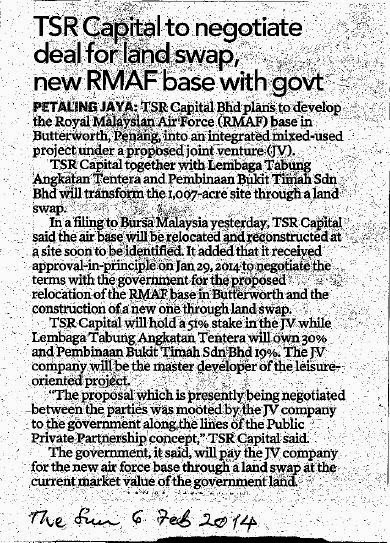
P.S. A sad development reported in The Sun on 6 February 2014: