This article, written by Prof. E.M. Beck and published in www.avweb.com's vol. 21 number 49A issue on December 1, 2014, fully explains the decline in the number of private pilots in the USA but equally applies to many other countries.
As a baby boomer, I too have been affected by the factors mentioned in the article. Obviously I am envious of Prof. Beck who still logs a hundred hours a year in his own Cardinal helping out in conservation.
Prof Beck writes....
GA's Difficult Climb Back
I am a 68 year-old Baby Boomer who got his private certificate in 1975 with the University of Michigan Flyers at the Ann Arbor, Michigan Airport. At that time, the Flyers had five Cessna 150s, a Skyhawk, a Piper Arrow, and a Citabria. Within a few months, a twin was added to the fleet—which continued to grow. There were some 200 University students, and some faculty, involved and most of the Club instructors were students at the U. There was an excitement about aviation. Every fall, club members taxied one of the Cessna 150s, with a police escort, into the center of Ann Arbor in the middle of the night and displayed it on the "Diag" for a few days to advertise the flying club. Students joined by the dozens. Today the Flyers has five planes and a hundred members. The club is doing well, partially due to its relationship with the U of M aero engineering program. Elsewhere the situation is not so encouraging. Population Shrinkage
Another way to view the situation is to consider the number of private certificates relative to the prime age group of potential pilots, 18-64 year olds. In 1970 that rate was 267.6 private pilot certificates per 100,000 persons 18-64 years old. By 2012, the rate had deteriorated to a mere 97.3 per 100,000—that's a whopping 63.4% decline in the age-adjusted rate of private pilot certificates over four decades. In fact, today's rate is significantly lower than it was in 1960. Recently I read where some politician was preaching the feel-good line that if only the government would get off the back of aviation, private aviation would flourish. He speculated that the decline in the numbers of pilots was due to governmental over-regulation and bureaucracy. While that position may be the "politically correct" spin in some circles, it is naive and oblivious to the more salient issues that private aviation faces. Such simple-think ignores the importance of history, economics, demography, and cultural change, and how they are interacting to decimate private aviation as we knew it. Mortality Among World War II Era Pilots.The downturn in private pilot certificates that started in 1980 was likely initiated when many of the World War II and early Post-World War II era pilots began entering their late 50s and early 60s. That generation of pilots grew up during the Great Depression suffering the stresses of hard times and then a world war, and had lower life expectancy as well as lower survival rates (the percent surviving at a given age) than the more recently born.Rise of the Boomers and the Allure of Aviation.
The explosion of babies born between 1946 and 1964 had transformative effects on the U.S. Between 1960 and 1980 the percent of the population between 15 and 34 years old grew from 26.1% to over 35%, but has been declining since and is now down to only 27.4 percent, the lowest it has been in 40 years. The abundance of these young Boomers formed much of the foundation for the expansion of private aviation in the 1970s and early 1980s, as did the World War II generation in the 1950s. The Boomers are now our aging pilots and ex-pilots and there is no comparable cohort of young persons to fill their shoes. The decline in the U.S. birthrate has meant that the population is aging and that there are relatively fewer young persons in the demographic pipeline. But it is not simply about numbers alone. Like almost all my boyhood friends, I was fascinated with airplanes and the fantasy of buzzing around the sky mimicking John Wayne in The High and The Mighty, or leading a flight of B-17s to Berlin as in 12 0'Clock High. We were mesmerized by the 1957 production of the Spirit of St. Louis and inspired by the courage of Charles Lindbergh facing the Atlantic alone. The weekly episodes of Sky King ripping up the western skies in "Songbird" portended the adventures a pilot could expect. Homer Hickham's West Virginian Rocket Boys weren't the only Boomers who turned their dreams to rocketry, astronauts, and space travel. Even commercial aviation was a glamorous voyage romanticized by Hollywood and the airlines. That was then. Although I don't have the data at hand to prove the point, I'll bet that the sales of model airplane kits, aviation magazines, the frequency of and attendance at air shows, membership in aviation organizations, or other low-cost indicators of aviation interest have either fallen in absolute numbers over the past four decades, or not kept up with the growth of the population. In short, I argue that younger Americans, by and large, don't see aviation through the same rose-colored goggles the Boomers did when they were younger. Relatedly, I suspect that the relative lack of Post-Boomer enthusiasm for aviation is matched by their lack of interest in automobiles and car culture—something that was a core interest to many Boomers. Simply put, the interests of today's younger Americans don't parallel those of the Boomers when they were younger. Times have changed and there's no reason to expect the culture that was unique to mid-to-late Twentieth Century will return in the Twenty-first Century. Economics I: Affordability.Virtually every time someone asks about the cost of getting a license and owning or renting a plane, after I finish explaining the realistic costs the typical reaction is the incredulous eye-roll and simultaneous jaw drop. To say that aviation is a hard sell would be a monumental understatement, even to those who might have some latent interest.
It is quite reasonable to argue that the most recent 160 h.p. Cessna 172R, at $274,900, is a vastly superior plane to a 1967 Skyhawk which retailed for $12,750. However, that misses the essential question of affordability; in other words, the price of an airplane relative to prevailing incomes. Between 1967 and 1980, the price of a new Cessna Skyhawk averaged 162% of median white household income. In 2012 that $274,900 Skyhawk was 512% of median white household income. While airplane prices have soared, median white household income has grown since 1967 by only 20% in inflation-adjusted dollars—the big growth in income has been experienced only by the most affluent 5% whose real income has almost doubled since '67. If we use the average income for all households rather than just white households, the affordability comparisons are even more striking. It doesn't appear this has been lost on general aviation manufacturers: there's more profit in selling a few very expensive airplanes, made with a significantly smaller workforce, to the very richest and status-conscious persons and corporations than trying to sell many planes to a population with relatively stagnant income. Furthermore, the recent unprecedented and breath-taking hike in the costs of Cessna factory replacement parts would seem to signal an unwillingness to maintain legacy aircraft, or at least supply parts only to the most desperate and well-heeled aircraft owners. Certainly FAA requirements since 1950 for improved seat belts and shoulder straps, transponders, altitude encoders, ELTs, Part 23 Certification standards, myriad ADs on engines, airframes, and accessories, requirements for flight reviews, etc., and most recently the ADS-B mandate, have all driven up the cost of private aviation. Those requirements have been largely incremental over a long period of time and would seem to be insufficient by themselves to explain the steep increase in aircraft prices since the 1980s. In addition to the FAA other favorite whipping-boys of aviation pundits include engine, avionics, and airframe manufacturers, liability lawyers, the courts, petroleum and insurance companies, and FBOs and repair shops. Clearly all have had a role in the escalating costs of private aviation. It has been suggested that simplifying Part 23 Certification standards could promote innovation and yield significantly lower costs without reducing safety. Possibly, but it is not known what those changes would be, how airframe, engine, and accessory manufacturers will react, and in any regard, any rule changes are a long way off. Further, even if such changes reduce costs to the manufacturer, where's the guarantee that those will be passed along to the end user and not remain in-house as additional profit. Economics II: Competing Expenditures.Obviously acquiring a pilot's license and buying or renting an airplane has to compete against all other possible uses of disposable income. Consider just two of the many changes that have impacted that allocation of income: first, many Boomers (perhaps most) worked for employers who offered guaranteed benefit pensions and bore much of the cost of health insurance. That is rarely the case these days. Many (perhaps most) non-Boomers work for companies that don't offer that traditional pension and comprehensive health care coverage, so they are having to squirrel away money for retirement in 401k's as well as making more significant contributions to health insurance. Second, the escalating cost of higher education for one's children can't be ignored since most state colleges and universities have been forced to shift their revenue stream from state government support to tuition paid by parents. When one is worried about medical costs, retirement, the kids' education, and other high priority concerns, thoughts of private aviation have all the substance of a wispy pipe dream.Bottom LineThe halcyon days of general aviation in the 1970's were the result of historically unique factors coming together: a relatively strong economy with a large share of well-paying jobs and a swell in the percentage of the population of young adults—many of whom came of age in an era when aviation, including military, commercial and private aviation, was adventurous, exciting, romantic, and very cool. Those days are past, and they are not coming back despite political speeches and wishful thinking otherwise. Demographics and economics rule.Given the very low U.S. birthrate, which is at or below replacement rate, the population will continue to age unless there is a dramatic increase in immigration (most immigrants are younger), and given the widespread hostility toward immigration, it's hard to see that happening. On the economic side, to increase the affordability of airplanes two things would have to happen simultaneously: (1) airframe, engine, avionics, and accessory manufacturers would have to make large price cuts in their products and services, and (2) prevailing wage levels for a large proportion of working Americans would have to increase to levels significantly higher in real, inflation-adjusted dollars than those of the 1970s in order to compensate for today's greater share of disposable income going for retirement, health care, and education. And lastly, on the cultural side, there would need to be a transformation causing young persons to change their attitude toward aviation and become as "hooked" as did many of the Baby Boomer generation. It is very difficult to envision, at least to me, those kinds of fundamental changes in demography, economics, and culture taking place, and so what can be said about the future?
|
Showing posts with label Aviation. Show all posts
Showing posts with label Aviation. Show all posts
Monday, December 1, 2014
The Dwindling Number Of Private Pilots


Monday, October 28, 2013
The Red Bull Air Race Returns
The last Red Bull Air Race (RBAR) was held at the EuroSpeedway racetrack in Lausitz, Germany on August 8, 2010. The race was won by Hannes Arch but the season's championship went to Paul Bonhomme who scored 64 against Arch's 60 points. Arch won 4 races and Bonhomme 2 in the 6-race 2010 season.
I thought that was the last we would hear of the RBAR but now I am overjoyed that it is starting again in 2014 and the icing on the cake is that the second race of the season will be held in Putrajaya, practically on my doorsteps. Hopefully I can shoot some nice videos of thr race myself. Below is my collection of videos that I purchased off the net and which covered previous RBARs.


For 2014, I am counting on Arch to be the champion as his performance since his first participation in 2007 has been impressive. He won in 2008 and was second in 2009 and 2010.
Monday, July 22, 2013
Fly-In To Phuket
Fly-Ins are always fun and I
decided to organise one in November of 1988 but with a big difference. The
destination was to be in a neighbouring country, Thailand, which I had never
flown to in a light aircraft before. It turned out to be most enjoyable but at
the same time it put the travelers through some unsavoury experience.
Having no experience in such
undertakings, I consulted those who had made cross border flights before and
began by applying through our Malaysian Foreign Ministry for a diplomatic clearance
by the Thai authorities. This was done two months ahead of the event and after
I had made all the interested participants place sufficient funds with my
flying club to cover the aircraft rental and fuel expenses. The aircraft
particulars, route details as well as the names and passport numbers of the
pilots and passengers were furnished together with the application.
One week before our
departure date, I enquired from the Foreign Ministry about the Diplomatic
Clearance and was told that no news had been received from Thailand. I then
visited the local Thai Embassy and was advised to pursue the matter with our
Foreign Ministry as our application was made there and not through them. I
called the Ministry daily until the day before our scheduled departure. On the
eve of our departure at 6.00pm a call came from the Ministry with the
Diplomatic Clearance number. I immediately filed the flight plan with the
control tower quoting the reference number. All the group members were already
on tenterhooks by then as it had been a long wait without any indication that
the fly-in would materialise.
We had only two C172s
available and had to turn away many members. Only those who paid first were
given places. I however managed to rent a PA22 from a flight training school on
condition the aircraft PIC was an instructor from the same school and that we would
bear his lodging expenses. I agreed to this and we therefore were able to
accommodate three more individuals excluding the pilot into the party.
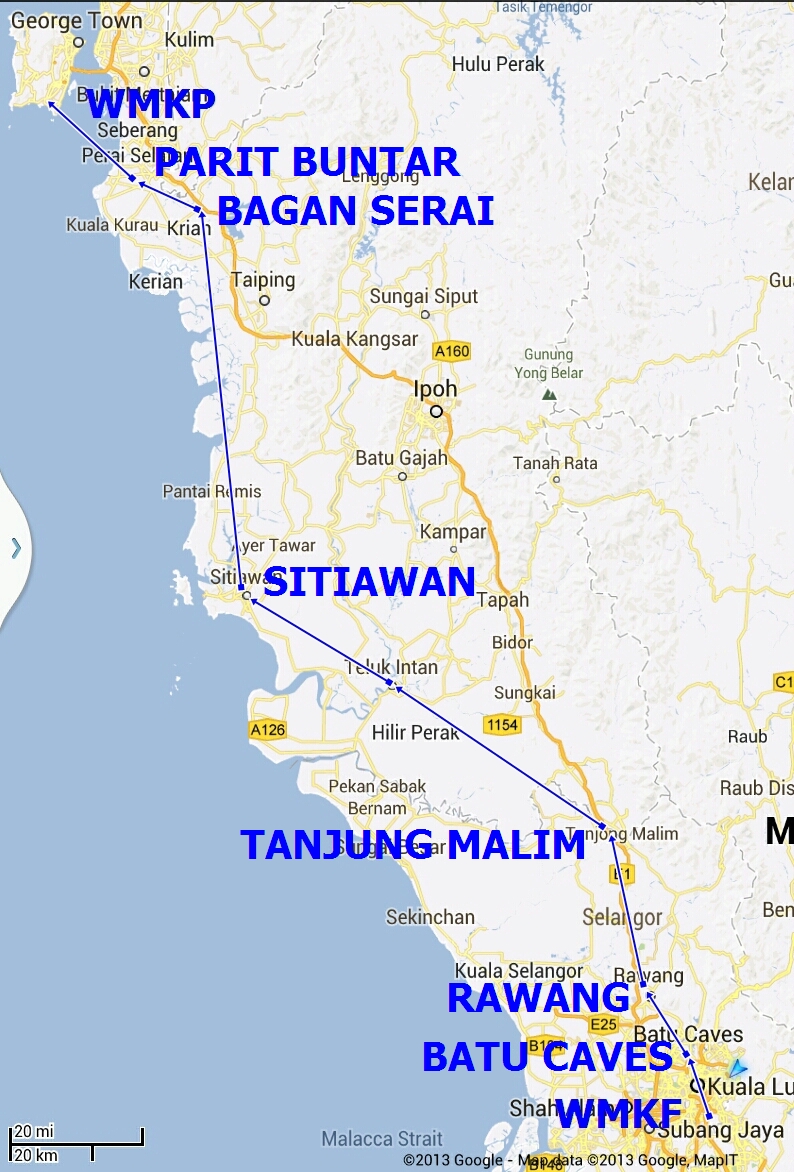
The first leg took us from Kuala
Lumpur to Penang, a two-hour flight at 4000ft and tracking via Batu Caves,
Rawang, Tg Malim, Teluk Intan, Sitiawan and Bagan Serai. Flying in company and
with weather being excellent, the three aircraft's crews and passengers had
spectacular views of the morning sun throwing its rays from the four o'clock
position onto the hills and plains to our left. As planned, we descended after
Bagan Serai for Penang International Airport where we landed one by one, refueled
and had some refreshments. As it was our point of exit from Malaysia, we went
through Customs and Immigration before taking off for our destination Phuket (it
is pronounced “poo kate’ and not with an F).


We took off in turn from
Runway 04 Penang, taking us over the city of Georgetown with its Komtar
building dominating the skyline and then the scenic beaches of Tanjung Bunga from
where we began our island hopping legs. After about forty minutes, Langkawi
Island appeared on the horizon like a legendary tropical isle. Overflying it,
we approached the international boundary further north into Thailand, an
airspace I had not flown in on my own before. From then on numerous islands of
varying sizes passed below us, each with its own white sandy beaches and rocky
outcrops. Among the larger islands were, as we flew northwards, Ko Tarutau, Ko
Ta Li Bong, Ko Lanta Yai, the two Ko Phi Phi's and Ko Yao Yai (“ko” means
island in the Thai language) before we swung left to Phuket airport. The most
spectacular was Big Phi Phi (Phi Phi Don) with its two crescent lagoons that
glimmered in the sunlight. The smaller Phi Phi Leh was more rocky but had
hidden beaches below the rocks and was the setting for both the movies
"Blue Lagoon" and "The Beach". I then realised how
fortunate I was to be able to have such magnificent views of the islands which
not many can have unless they fly that low.
Throughout the flight into
Thai airspace, the ATC service was excellent and we had not much difficulty in
communicating with the controllers. We were cleared for Runway 27 Phuket and
taxied down the long undulating runway to the parking ramp to the end on our
left. Immigration, customs and health checks proceeded without fuss and we were
soon on our way to our hotel on the touristy Patong beach.
The next morning, we
obtained clearance from the friendly ATC personnel to fly on a circuit around
the island at 1,000 feet and so all three aircraft took off on Runway 09,
turned right and began our clockwise journey over the several beautiful beaches
that ring the island. The flight was most exhilarating and soon we were back to
the airport for a landing. We stayed another night in Phuket partaking in the
delicious local cuisine and shopping for some clothing items.
Sunday morning came and it
was time to head for the airport for our return flight. Upon arrival, we filed
our flight plans and were told that we had to pay for parking and landing fees
which came to US$100 per aircraft. This was something we never expected as back
home this would have amounted to not more than US$5 per aircraft. In response
to our disbelief, the controller showed us their book of charges which
indicated a minimum of US$50 per night for aircraft of below a certain weight.
We sensed that the rate probably applied to commercial aircraft but we realised
that we had to go home and the argument was not going to be settled soon or in
our favour. We paid up after collecting cash from the team members.
Our ordeal had just begun.
With the receipt in my hand, we went through passport and customs checks.
Apparently immigration and customs officers on duty were working on overtime on
Sundays and needed to be paid. More cash was dispensed. Oh, they even issued us
receipts for these payments though we could not read what were written as there
were no English words on them.
As we walked across the ramp
to our aircraft, we requested for the fuel bowser to be sent round for
refueling. Again another ingenious response came . The bowser driver was at
home as it was a Sunday but he could be summoned to come over if we agreed to
pay his taxi fare and overtime. We suspected he was just lazing behind the
office building. More cash was dispensed. Finally we were airborne again over
the scenic Andaman Sea with its beautiful islands as we winged our way south
for home.
The episode did not end
then. Some weeks later we received an invoice from the Thai airport company
requesting for a further sum from us for "navigation charges" based
on the actual distances flown within Thai territory. I cannot recall the exact
sum but it was maybe another US$50 per aircraft. All the team members paid
their share as to act otherwise would mean putting our club on their blacklist and
causing future fly-in requests by our club members to be rejected.
Upon my return, I described
our experience to a senior club member who responded with his own story of how
he faced a similar situation in Kupang, Indonesia when he flew there in our
club aircraft a few years earlier. In his case, he was told that the airport
had not received the diplomatic clearance telex from their head office and that
he would not be allowed to take off until the receipt of that telex. After a
small payment, the telex was found in a desk drawer somewhere.
Despite the traps that may be
sprung upon a pilot landing his plane in a foreign country, the adventure
element in making a first flying visit to that destination may still goad him
to risk it. The satisfaction of seeing new places spread below one's eyes from
a thousand feet up and landing on foreign soil is irresistible.
Tuesday, June 11, 2013
A Memorable Flight
In the many flights that I had made over the years, of
course many are memorable ones but one that put a big smile on my face was when
I completed my first cross country flight into an international airport, one which
I had never flown to on my own before.
Planning the flight was a joy as I laid out the 1:500 map
and plotted my intended path, measured the distances of the legs and worked out
the details for my navlog entries. On the morning of the flight, I filed the
flight plan, checked the weather (which was forecasted to be good) and preflighted
the aircraft. It had two tanks full of fuel and with one passenger tagging along,
had just the right setup for a pleasant flight.
I had over 20 PIC hours by then and confidently flew the
flight plan on VFR using the navlog and relating the ground features to the map
as we went along. Every inch of the flight was under ATC and I had no problem
with that as I switched from station to station on the way. GPS was too expensive
then, so concentration was really required to ensure we were always on track by
matching the ground features with the corresponding items on the map.
Finally we entered the penultimate leg but just then ATC directed
us to a location that was not in my flight plan. Fortunately I could find it on
the map. It was a small fishing village on the coast and we tracked towards it using
the compass and by looking at the shape of the coastline . That was the only heart
stopping event we encountered. We were told to hold over that village as we approached
it and so we just circled above it. There was airline traffic around the airport
at that time. Eventually we were cleared to descend and join right base for Runway
04. The airport is located on an island and there is a hill that flanks the seaward
side of the runway. We therefore had to track across the sea from the mainland while
descending to circuit height, join downwind on the other side of the hill from
the runway and continue until we could see the runway end before turning base.
We were cleared to land and I touched down just after the piano
keys, turned off the runway at the next exit and was told to hold to allow a B737
to pass along the main taxiway in front of me. This was the first time ever that
I sat as a pilot in a plane watching a jetliner taxi right in front of my nose at
a busy airport. At that instant I imagined myself being at the controls of another
B737 just doing my job as an airline pilot. It was a totally different scenario
from what I was used to in my earlier flying days as a student pilot where the traffic
was mainly GA and some military aircraft.


A SIMILAR SCENE AT ANOTHER AIRPORT
We were cleared to proceed to the ramp near the tower and as
we did other jetliners were pushing back for departure. The vista, sounds of jet
engines, ground vehicles crawling around and ATC chatter in my headphone were something
that gave me a glow of satisfaction, a feeling that I had arrived literally and
figuratively into the aviation world. How can I ever forget that wonderful day.
Sunday, May 12, 2013
Learning From The Instructors
As I reminisce, it seems that a lot had been added to my collection
of flying techniques since the day I had my first lesson. Yet I find that the
most critical and useful techniques were actually taught me during the first fifty
hours of flying. For this I have my instructors to thank for. I was lucky to have
had two highly competent individuals as my mentors.
The first was Manjit. He was a tall handsome young man who was
collecting his hours before he could join the airlines. He was methodical in
presenting his preflight brief and would ask me quick questions on the aircraft
as we walked to it, inside it and later as we walked back for our debriefs. Questions
could vary from how much fuel could the tanks take to why the wings wash out at
the tips. In the air he would ask if the engine would cut out if he switched off
the ignition, and then as I said yes, proceeded to actually switch it off. Manjit
led me to my solo by which time I had the answers to most, if not all, the
questions.
After soloing, another instructor took over my training. Chandran
was a QFI (Qualified Flying Instructor) and was quite elderly with an above
average girth. He was soft-spoken and a man of few words. If he ever raised his
voice, it would be a scream to get me to add power when we were sinking too
fast or to go around when we were too high or in such similar situations.
Like Manjit did, Chandran too made me master the mnemonics which
remain with me till today. From HASELL to TVMDC, the mnemonics will never be forgotten
and have been found to be useful in times of need.
Chandran had these tricks and formulae to make complex procedures
simple. With short and sharp instructions, he would guide me as to what the requirements
are for, say, a good approach. "Before base speed 80kts, flaps one, speed 70kts,
turn base and descend....turn to final to complete by 300ft AGL, flaps two...speed
65kts, descent rate 200fpm..." and on he went. Most of the time his formulae
worked and I lived by them.
One of my favourite destinations was Tioman Island less than
two hours flying time away from my base. Although exotic in itself (the island “Bali
Hai” in the musical movie “South Pacific” is in real life that island), the
attraction to pilots is because its 900-metre runway is enclosed on three sides
by steep hill slopes and the fourth side by the sea.

Only pilots checked out on the airport by an instructor are
allowed to land there. Chandran had a simple formula for landing there –
establish right base at 300ft AGL on feet dry, cling close to the hill on the
left while descending, turn final and select full flaps while skimming the
grove of coconut palms that stretch to the runway’s edge, then when clear of
the palms, cut power completely, push the aircraft down to the runway and
ensure that it drops on its main wheels carrier-style. “Don’t worry,” he said,
“the Cessna’s main undercarriage is made for heavy landings.” In later years, the runway was lengthened and the palms on the approach cleared away.

CHANDRAN'S FORMULA
(AFTER RUNWAY EXTENSION)

EARLY BASE VIEW
(BEFORE RUNWAY EXTENSION)
Wikipedia
I have never had any problem landing at the island despite
tailwinds sometimes and I owe one to Chandran. As I continued flying over the
years, Manjit’s and Chandran’s words constantly echoed in my head guiding me to
do the right things as the situations demanded.
Wednesday, February 13, 2013
TRIBUTE TO THE LATE COL. (Rtd) ZAKARIA SALLEH
The late Col. Zakaria Salleh (whom everyone called Zak) was a small-built pilot but his aerial exploits and the significant contributions he made to general aviation in Southeast Asia was legendary.
I first met Zak when he was teaching several of us to fly the Quicksilver ultralight during his spare time. We were flying at various open spaces which were pending development and as soon as construction work started at these sites, we had to move like nomads to new flying sites. At that time Zak held the rank of Flying Officer in the air force and was flying F5 jet fighters. I then lost touch with him as I progressed to Cessnas and flew at proper airfields.
Several years later, Zak started instructing at the Royal Selangor Flying Club where I was regularly flying from. He was ater elected the Club Captain and was responsible for all flying activities of the club. In this role he organised regular fly-ins, open days, flying competitions and air shows. I enjoyed participating in most of these events which took us to various airports and airstrips not only within Malaysia but also in the neighbouring countries.
 |
| A FLY-IN TO PESTA LUMUT IN 1991 Zak is circled The writer is second from left. |
Subsequently Zak retired from the air force with the rank of Colonel and having flown various fighter types like the CL-41G Tutor, Northrop F5 and A4 Skyhawk. He then flew target tugs and later several bizjets for a living. His flying and organising skills were recognised and he was subsequently elected as President of the Malaysian Sports Aviation Federation which is the umbrella organisation for all sports aviation related bodies in the country.
Zak loved aerobatics and formation flying and would put on impressive flying maneouvres at various air shows in the region. He was most famous for leading the Eagle 150 Aerobatic Team which regularly took part in the country's Independence Day parade flypasts and in air shows overseas. On occasions where the Eagle aircraft were not available, he would call up several pilots from various flying clubs and still put on a commendable performance. I was glad to join in and fly on some of these events.
 |
| PILOTS AFTER A FORMATION FLIGHT (Zak is circled. The writer is second from right) |
The Eagle 150 was a highly aerobatic aircraft and in the hands of someone like Zak, it was capable of some magnificient stunts that never failed to impress crowds. Zak, however, yearned for more. He went out and bought a dedicated aerobatic aircraft, the Christen Eagle, from the US. This was the aircraft he loved and with it he went on to mesmerise the crowds with his superb flying skills.
 |
| A CHRISTEN EAGLE AEROBATIC AIRCRAFT (Wikipedia) |
On June 23, 2011, while performing aerobatics in front of an air show crowd in Padang, Indonesia, his Christen Eagle slid down from a vertical climb and crashed to the ground. His wife, Leila, was watching from the stands. Zak passed away in hospital shortly after.
 |
| ZAK LEADING HIS EAGLE 150 OUT OF A HANGAR IN PEKANBARU AIRPORT |
To Leila and the family, I send my deepest condolence. Zak was a good friend and helpful at all times especially in my flying activities. He is well-known in the flying fraternity in Malaysia as well as in the neghbouring countries. We shall always remember him.
Friday, August 17, 2012
Crosswind Landings and A Surprise 35-knot Headwind
WEATHER
Malaysia is considered a mild climate country as there is no extreme temperature. Most of the time it lies between 28C to 33C in the afternoon with a drop of about 3C in the early morning in the lowlands where most people live. Similarly winds in Malaysia rarely reach above 20 knots, so pilots generally have little experience in handling strong crosswinds during landing. For mild crosswinds, some training in crabbing and sideslipping techniques for landing is usually made mandatory .
LANDING TECHNIQUES
In the former, the nose of the aircraft is deliberately pointed at an angle into the wind to counteract the otherwise sideways drift leewards. So, instead of pointing straight towards the runway, the aircraft is "crabbed" towards it. Moments before the wheels touch the runway, the nose is swung back to align with the centreline on the runway so that the wheels will roll forward as normal and not be dragged sideways causing the aircraft to skip or even topple on its side.
The latter technique involves lowering the windward wing while keeping the nose pointed straight towards the runway. The resulting sideways lift of the wings will counteract the otherwise leeward drift. The disadvantage of this technique is that the plane will sink faster towards the ground as the wings' vertical lift is now reduced by its sideways component which was created by banking the wings windward. The advantage of this technique, however, is that one can come in higher than normal and still be able to land on the threshold (a spot just after the edge of the runway marked with white stripes nicknamed "piano keys").
I have occasionally used both techniques over the course of my flying years but there was one instance when I could not use them and had to quickly devise my own technique. This was because this time the wind was coming from the front at about a 15-degree tangence but the wind speed was 35 knots!
THUNDERSTORM
Here is how it all started. It was a bright day and I thought I would put in a half-hour to one-hour flight within the training area called R218. This area is a reasonably wide corridor that lies roughly between Kajang (2 minutes away from Sempang, our home airfield) and Semenyih. It has an upper limit of 2,500 feet and is used for training purposes as well as a transit lane for flights to and from the south. I scanned the sky before preflighting the aircraft and noted some rain clouds in the distance over Subang 6 miles away. They did not look threatening at all.
After obtaining Air Traffic Control (ATC) clearances, I took off and practised some manoeuvres within the training area. After about 30 minutes, ATC radioed me that the weather was closing in on the airfield and I was advised to return to base. As I neared Bukit Besi overlooking the airfield, there was a huge dark cloud hanging right on top of the runway and ATC advised that I was cleared to land with the surface wind indicating 200 degrees at 35 knots. Never had I heard such a strong wind from any ATC before but I believed it because that huge cumulonimbus cloud had a base at only around 2,000 feet. I could see the trees around the airfield swaying wildly. ATC then came on with a polite question "Do you need any assistance?" which they always say when they think a pilot or an aircraft might be in trouble.
LANDING
I assessed the situation as I turned right to join downwind at 1,000 feet for a left-handed pattern for Runway 22. With the wind almost head on at 35 knots and my normal final approach speed at 60 knots, my airspeed would show 95 knots when I touch down but the ground speed would be just 60 knots. This could not be the usual landing using flaps anymore as the flap limiting speed is only 80 knots and an airspeed of 95 knots might just rip them off. A flapless approach at an airspeed of 105 knots (normal flapless approach is at 70 knots) would just do the job, so I told ATC "Final, no flaps" which he acknowledged. By that time the sky had opened up and heavy rain was pouring on the aircraft and the airfield. It was a totally new experience for me to see the Airspeed Indicator (ASI) showing more than 100 knots as I touched down smoothly without flaps. All my previous no-flap landings over the years had not more than 70 knots or thereabouts on the ASI, so it was hard to believe that I was doing what I did as I descended the last 300 feet onto the runway and rolled out. The arithmetic has once again been proven - 105 knots on the ASI with a 35-knot headwind is equal to a 70-knot landing.
PARKING IN THE WATER
I thanked the ATC as I taxied into the ramp and stopped the aircraft. Another problem had however just cropped up. There was no umbrella in the plane and there was no way I could run into the hangar without getting drenched to the skin. So I waited it out in the cockpit for about half an hour before the rain finally eased. By then the aircraft's wheels were totally submerged in water. I removed my shoes and socks, rolled up my pant legs and waded to the hangar. So much for the Malaysian weather, a short flight in a bright sky can turn into a freaking thunderstorm and flooding in less than 45 minutes.
LANDING
I assessed the situation as I turned right to join downwind at 1,000 feet for a left-handed pattern for Runway 22. With the wind almost head on at 35 knots and my normal final approach speed at 60 knots, my airspeed would show 95 knots when I touch down but the ground speed would be just 60 knots. This could not be the usual landing using flaps anymore as the flap limiting speed is only 80 knots and an airspeed of 95 knots might just rip them off. A flapless approach at an airspeed of 105 knots (normal flapless approach is at 70 knots) would just do the job, so I told ATC "Final, no flaps" which he acknowledged. By that time the sky had opened up and heavy rain was pouring on the aircraft and the airfield. It was a totally new experience for me to see the Airspeed Indicator (ASI) showing more than 100 knots as I touched down smoothly without flaps. All my previous no-flap landings over the years had not more than 70 knots or thereabouts on the ASI, so it was hard to believe that I was doing what I did as I descended the last 300 feet onto the runway and rolled out. The arithmetic has once again been proven - 105 knots on the ASI with a 35-knot headwind is equal to a 70-knot landing.
PARKING IN THE WATER
I thanked the ATC as I taxied into the ramp and stopped the aircraft. Another problem had however just cropped up. There was no umbrella in the plane and there was no way I could run into the hangar without getting drenched to the skin. So I waited it out in the cockpit for about half an hour before the rain finally eased. By then the aircraft's wheels were totally submerged in water. I removed my shoes and socks, rolled up my pant legs and waded to the hangar. So much for the Malaysian weather, a short flight in a bright sky can turn into a freaking thunderstorm and flooding in less than 45 minutes.
Monday, August 13, 2012
The Annual Haze (meaning Smoke)
Every year during the dry season West Peninsular Malaysia is covered with a blanket of smoke which the press strangely calls haze. This affects air traffic especially the smaller aircraft which do not have sophisticated navigation equipment. However the worst effect of the smoke is on health with many asthmatic and other lung ailment sufferers heading to hospitals for treatment. The smoke gets worse if no rain occurs.

SMOKE ENGULFS KL'S GOLDEN TRIANGLE
What is the cause of the smoke?
Sometimes it is the palm oil mills within the country itself that burn palm oil husk as fuel to sterilize the fresh fruit bunches in the process of manufacturing crude palm oil. Having flown over many parts of the country at a few thousand feet above the ground, I have witnessed extensive pollution of the air from these mills especially on flights between KL and Melaka and between KL and Ipoh. In Melaka especially, the airport can hardly be seen when one is just 5 miles away. It gets pretty dangerous as there are many aircraft from the flying training school flying around the airport and we can hardly see them. The smoke can be clearly seen streaming out of the mill chimney and spread around by the wind covering an area of perhaps 60 square miles.

A PALM OIL MILL IN OPERATION
The other source of the smoke is from Sumatra in Indonesia where forest is burned to cultivate oil palm. As palm oil is a major export for both Malaysia and Indonesia, much of the agricultural land is planted with oil palm. On satellite images, the "hotspots" where open burning occurs can clearly be pinpointed.

HOTSPOTS ON 14 AUGUST 2012
Courtesy of NOAA and Malaysian Meteorological Department
Yet another important source of the smoke is peat soil burning where the burning may occur deep underground after being ignited on the surface. Swamps generate peat which is used as fuel in many countries because it has high carbon content.
In one of my flights to Pekanbaru in Sumatra, I experienced thick smoke all the way. It was difficult for me to discern if the smoke came from deliberate burning of land for cultivation or accidental burning of peat land.

DUMAI AIRPORT EN ROUTE TO PEKANBARU

SEARCHING FOR PEKANBARU AIRPORT

AIRPORT VISIBLE IN THE SMOKE
FOR MORE PICTURES VISIT
Mysterious Incident In Good Weather
One incident that occurred while I was flying remains a mystery to me until today. It was during a flight home from Tioman Island to KL (Tioman being the island I fly to most often for reasons the reader will ultimately find out as he or she continues to read my blogs).
The weather was simply beautiful at that time which was around six in the evening and we were flying at 2,500 feet. When we were roughly abeam Genting Highlands on our right I saw the RPM Indicator suddenly reading 2,450 rpm (which for the C172 means that the propeller was turning at that speed). Normal cruise setting is usually 2,200 to 2,300 rpm during level flight.
I automatically assumed that the plane was diving because only when a plane is diving will the RPM increase by itself ( a result of gravity pulling the plane down and increasing its speed). So I pulled the control column back to maintain level flight and reduced the power by pulling the throttle lever back towards me. I managed to hold the nose level by pulling back hard on the control column and holding it there but the throttle lever was forcefully pulling itself back into the instrument panel. I pulled the throttle lever back again with all my strength but the engine responded by again pulling it back into the panel. The altimeter was showing that we were descending at about 100 feet per minute with my nose level which is not too alarming.

This tug of war between myself and the engine continued a few times and I was fearful that the throttle cable behind the panel would snap because the force that was pulling it back in was really great. If it had snapped, the engine would turn at maximum speed and, if prolonged, damage itself. Worse still I would then lose control of the delinquent aircraft. I looked at the Airspeed Indicator to see if the speed of the aircraft had increased correspondingly and it was up to about 100 knots, which is on the fast side but not yet in the danger zone. Probably by pulling hard on the control column I had managed to keep the plane's speed within limits (high speed can weaken the aircraft's structure).
There was nothing else I could do other than pray that the situation would not worsen. I had three passengers with me who had never flown in a small plane before this and I could not let them see that I was in trouble. I decided to descend a bit lower as we would soon be required by Air Traffic Control (ATC) to maintain 1,500 feet as we enter the KL control zone. This enabled me to reduce the pressure I was putting on the control column and I also would be able to test if the engine RPM would increase further as we descended. Just as suddenly as it started, the engine RPM normalised and became controllable again. I could pull the throttle lever back and forth without forcing it. Pressure on the control column was also relieved.
After changing the radio frequency from Lumpur Information's to Sempang Tower's, I was mighty glad to be able to speak to my home airport controllers again. What a satisfying feeling it was to land the aircraft as normal and without my passengers noticing any difference. It could have been a different story though.
I asked around but none of the pilots I spoke to had experienced it the way I did. I asked the engineer to check the plane thoroughly after the flight and he found nothing out of the normal. My guess is that I had entered an area of clear air turbulence (CAT) where there was a strong downdraft coming from the front of the aircraft. This would have increased both my propeller RPM and the airspeed while causing the plane to descend. However I still cannot believe the really strong force that was pulling the throttle lever back into the panel.
Friday, August 10, 2012
Does Flying Kill?
The answer is a definite yes. However there are precautions one can take to lessen the probability of that happening.
A. LOSS OF CONTROL
If the pilot is caught in a situation where he has lost control of the plane due to:
a) jammed or severed control links or
b) damaged or detached control surfaces
c) incapacitation
d) his seat has slipped and moved away from the controls for some reason and he is not able to reach them again
the plane will likely go down with the weight of the engine pulling the rest of the plane with it. Even if the engine is running perfectly, the inability of the pilot to maintain straight and level flight will mean gravity will take over and the plane will dive towards the ground with an increase in the rate of descent as it drops in altitude.
B. ENGINE FAILURE
If the plane is in perfect condition but all the engines fail, his survival depends on:
a) how near he is to a safe landing site and his altitude. He should not be too low as he needs to glide over that distance to the selected landing site or until he can make a midair restart.
Two famous incidents where the planes lost all power but managed to land with no loss of life are the US Airways Flight 1549 which landed on the Hudson River and British Airways Flight 38 which landed short of Heathrow Airport's runway.
b) If the plane has more than one engine and one fails, he is still able to fly to the nearest airport and land safely on the other engine(s) using asymmetric flying techniques.
C. RESPECT THE WEATHERMany aircraft incidents (other than from pilot error) are due to weather:
a) a violent storm in a rain cloud may rip the aircraft apart
b) hailstones may damage parts of an aircraft such as the propellor or control surfaces
c) ice may build up in the engine and block air or fuel from reaching it
d) ice may also accumulate on the wings altering their shape and making them lose their aerodynamic lift as well as increasing drag
e) visibility in a cloud may be so poor that the pilot cannot see an obstacle ahead. A billowing cloud may be nice to look at from afar and on a bright and sunny day but it is a totally different scenario from inside it.
Very often a pilot begins his flight in good weather but later encounters bad weather on his route. While most airliners can fly higher to avoid weather, small aircraft may not be able to do so and the pilot must decide whether to continue, divert to a safer airport or even return to his airport of origin.His decision can be a matter of life or death.
I have been in situations where even turning back has to be ruled out because clouds have begun to move in behind me. One then has to fly lower so as to be below the cloud base. This situation often happens in hilly areas because the moist winds move up the slopes and cool as they rise. The moisture then turns into clouds. When faced with this situation,a pilot has to "scud run" meaning he has to weave along the bottom of the valleys. He just prays that there is no dead end or a huge obstacle at the next turn.
D. SKILL AND EXPERIENCE
A pilot needs to be skilled to survive. Besides being meticulously trained, he needs the experience to enable him to foresee problems before they crop up, to read the weather, to understand the locality in which he flies, to know the capabilities and limitations of his aircraft and to remain calm and disciplined when faced with an emergency. An experienced pilot can tell when there is something not right with his aircraft by the feel of the control column, the attitude (position in relation to the horizon), the sound and vibration of the engine, etc.
There are certain emergency situations that a pilot can practice for. These include engine failure, fire during flight or on the ground, wheel brake failure, landing gear failure, electrical failure and other system malfunctions. The steps and procedures to overcome these must be followed precisely and repeatedly until they become second nature to him. When an actual emergency arises, he will automatically carry out the procedure on reflex as there usualy is insufficient time to think anymore.
All flights begin with preparation. The route must be drawn up with the required waypoints, altitudes, speeds and possible diversions (alternate airports) in case of weather changes or emergencies. Even the alternate airports have to be screened to ensure that they have the required runway length and facilities for refueling, etc. Weather forecasts for the length of the route have to be studied and the route modified accordingly.
The pilot himself must be in good condition with sufficient rest and food and appropriately clothed. If flying over water, life jackets must be carried. Survival equipment and first aid kit must also be on board. The aircraft must be in good flying condition with sufficient fuel including reserve in the tanks. The fuel must be checked for possible contamination.
A series of checks must be carried out before, during and after each flight. Comprehensive check lists are used to avoid missing anything. Missing a small check on the ground can mean a big problem in the air. If a fuel cap or baggage door is not secure, it may open in flight and there will be no volunteer to crawl out of the plane and re-secure it at a thousand feet above the ground. Similarly if one miscalculates the fuel quantity required, the aircraft may have to make an emergency landing on top of a tree.
F. A LESSON LEARNT

I had a not so funny experience once when flying with another pilot. It was a flight from KL to Tioman Island and back. I prepared the navlog (navigation log detailing the waypoints, compass headings, altitudes, leg times, etc.) for my outbound flight to Tioman and since the other pilot was to fly the return leg, I assumed that he had done the same for that leg. When we took off to return to KL, he asked me for the heading to fly. I mentally reversed all the compass directions from my navlog and gave him the first heading to follow. I had however absent mindedly given him the reverse of the first heading on my navlog, which was the KL-Kajang leg of 150 degrees, so reversing it resulted in 330 degrees.
It normally takes 34 minutes over the sea in a westerly direction to reach the next waypoint of Kuala Rompin. After thirty minutes out from Tioman we saw the coast some distance away to our left and sensed that something was not right. We nevertheless continued towards the coast and found ouselves over Kuantan,which is 100km to the north of where we were supposed to be. We had wasted some fuel by taking that diagonal track to the coast and now we had to take a longer route than planned to reach KL.
At that time the refueling facility at our home base in KL was unserviceable and all pilots were required to refuel at Subang airport nearby before returning, so we tracked for Subang. All this meant that we had to fly longer than our planned flight and our fuel was running low. At one point the engine sputtered for a number of seconds but then resumed running. We prayed that we really could reach Subang. This we miraculously did.
When the refueler looked into our tanks they were shocked to find no fuel inside. A failure to prepare a simple navlog could have spelt disaster for us. There were no GPSs those days (or they were too expensive then). Today, that incident would not have happened as a GPS will tell you exactly which heading to follow.
Perhaps another lesson learned from this episode is to always double check the information given you by another crew member. Even if one is told "the external checks have been completed", "we have 40 gallons of fuel", or "the minimum safety altitude is 2,500 feet", etc., it is wise to take a second independent look. In the above case, Kuala Rompin is directly to the west of Tioman, so a heading of 330 degrees should have made us question it. Sometimes when we are busy doing something else or in a hurry, simple things like that are missed.
DISCIPLINE
This is probably the greatest life saver to a pilot. Without it, a pilot's life may be short. As they say, there are no old bold pilots. As the captain of an aircraft, he must make decisions all the time concerning the safety of his aircraft and passengers. Should he refuse a flight if the weather is adverse or if a certain component of an aircraft is not functioning? Can he take a certain amount of risk and continue his flight? An inoperative fuel gauge may be acceptable if the tanks have been checked and found to be full but what if a leak develops during flight? He will have no way to check if there is still sufficient fuel on board. Similarly, should he carry more cargo and passengers and reduce his reserve fuel or should he upload more fuel than necessary to cater for diversions due to weather, wind conditions, traffic congestions, etc.? A disciplined pilot will take the minimum risk in all these matters but sometimes he has to relent when his employer insists on pushing the limits.
CONCLUSION
Yes, flying can kill but an aviator must fly (for whatever reason). As long as he is disciplined, puts in as much practice as possible and consciously carries out the recommended procedures, he probably can avoid getting into difficulties. As he logs more and more flying hours, he can only get better at it.
Monday, August 6, 2012
Buleleng Fly-In 2006
The Government authorities in the northern provinces of Bali island have always wanted the tourism business, which has largely been concentrated in the southern part of the island, to also reach their shores. After all there are many fine beaches, historical sites, cultural characteristics and other attractions there that many have passed over probably due to lack of publicity.
Since the beginning of the new millenium, a small airstrip had been established in Grokgak, Buleleng to cater for sports aviation. Several local and international aerial events have been held there and among them are the International Buleleng Fly-Ins. The first was held in 2001.This story covers the second in the series and this was held in early September 2006.
Ten years earlier, this writer had taken part in the Jakarta - Mataram - Jakarta Air Rally (see the story also in this blog) which stopped in Denpasar airport to the south on the way to and from Lombok island. So this was somewhat like a down-memory-lane trip for me.
It was Independence Day, August 31, 2006 and a few of our contingent members flew the ceremonial flypast in their Eagle 150s at the national parade in the morning. They were the Eagle Formation consisting of six aircraft. Our RSFC (Royal Selangor Flying Club) team comprised two C172s (9M-BDX and 9M-RFC) using the callsign Selangor Formation. In addition the C172 of the Perak Aero Club 9M-RMW was assigned to be the third member of our formation. Another batch of aircraft used the callsign Pahang Formation.
I was flying the lead aircraft 9M-BDX and the other two were to formate on me at all times during the whole event.

Our two RSFC C172s flew from KL to Melaka to meet up with other aircraft from the rest of Peninsular Malaysia. We all assembled at Melaka Airport (WMKM) for our Immigration and Customs clearances and after refueling left in formations for Pekanbaru Airport (WIBB) in Sumatra.

REFUELING, CUSTOMS AND IMMIGRATION AT MELAKA
The flight took us across the Melaka Straits, overflying the RUMID and SALAX intersections and Dumai Airport (WIBD) and took us almost two hours.
Pekanbaru's Sultan Syarif Kasim II is a joint civil/military airfield and I had flown to this airport two years earlier to take part in the Pekanbaru Air Sports Show (PASS). The TNI-AU (Indonesian Armed Forces - Air Force) took care of our immigration and customs clearance without any hassle. We were supposed to immediately refuel and continue to Palembang Airport but unfortunately the avgas for our aircraft had not even left its depot at Medan, meaning that we had to spend the night in Pekanbaru. The fuel only arrived mid-morning the next day (1 September 2006) and we left for Palembang at almost noon.

THE 3 EAGLES & THE OTHER C172 HANGARED AT PEKANBARU

FUEL ARRIVED FROM MEDAN THE NEXT MORNING

SEVERAL HAWKS TAXIED OUT WHILE WE REFUELED

TOWING AN EAGLE TO THE FLIGHTLINE
(In front is the late Kol. Zakaria who perished in an air show at Padang airport on 23 June 2011) )

OUR C172 BEING REFUELED

AN ADAM AIR B737 TAKING OFF FROM PEKANBARU
(The airline was shut down by the aurhorities two years later. In the background is the civil terminal)
After a long 3 1/2 hour flight we arrived at Palembang (WIPP) which, like most Indonesian airports, is a joint civil and military airport. We were parked on the military side. All our Malaysian formations stopped to refuel here before proceeding on the next 3-hour plus leg to Halim in Jakarta.

A COLUMBIA BEING REFUELED WHILE AN EAGLE WAITS

PALEMBANG AIRPORT SEEN FROM THE MILITARY SIDE
Selangor 3 (9M-RMW) had by then discovered that their cruise speed was higher than those of Selangor 1 and Selangor 2. They decided to proceed on their own after Palembang.

Less than an hour after we left Palembang, low cumulonimbus clouds began to restrict visibility for the rest of the leg. We had to fly low to keep the ground in sight.
As we neared the city of Bandar Lampung, Selangor 2 (9M-RFC) radioed that their AHI (artificial horizon indicator) gyro had toppled due to vacuum failure and that they could not navigate safely in the poor visibility. They decided to land at the local airport of Raden Inten (WICT) and try to resume their flight when the weather improves perhaps the next morning.
(The crew attempted to resume their flight the next day but had to return to WICT as the weather persisted over the next few days. As there was no avgas there, they decided to abandon their flight altogether, enjoy their enforced holiday there and wait for us to ferry them fuel on our return leg five days down the road.)
Our aircraft became the sole remaining member of Selangor Formation and so we decided to switch our callsign to 9M-BDX, continued on in the foul weather and arrived at Halim in Jakarta as darkness encroached.
Halim is a military/civil airport serving the domestic carriers and GA (general aviation) aircraft. It is noted for the number and variety of old aircraft found there, some of which were still in good flying condition. We spent the night in a hotel in Jakarta anticipating a dawn takeoff the next day.

A C172 FROM IPOH AT HALIM PARKING
After refuelling early the next morning (2 September 2006) we flew eastward past Cirebon and onward to Semarang (WARS), another joint civil and military airport north of Central Java. This was a 2 1/4 hour flight.

We had an early lunch while our aircraft were refuelled and then continued eastward to Bali passing along the way the large military/civil airport of Surabaya on the northeastern tip of Java Island. After 3 1/4 hours we reached the norwestern tip of Bali island.

OUR AIRCRAFT PARKED AT SEMARANG
We had an early lunch while our aircraft were refuelled and then continued eastward to Bali passing along the way the large military/civil airport of Surabaya on the northeastern tip of Java Island. After 3 1/4 hours we reached the norwestern tip of Bali island.
LetKol Wisnu Airport in Gerokgak, Buleleng has a 700 metre paved runway with the northern end surrounded by trees and the other end close to hills. Approach is recommended from the Runway 14 end and the aircraft has to be dropped onto the threshhold after clearing the edge of the trees.
My wife arrived in Denpasar after flying commercial from KL via Jakarta and was waiting at the Wisnu terminal when we arrived in our C172.

THE TERMINAL AT WISNU AIRFIELD

THE STAGE FOR THE OPENING CEREMONY

THE ATC TENT ON THE LEFT
(Open burning by villagers in the background)

A TV CORRESPONDENT MAKING HIS REPORT
(Participating aircraft in background is a Zenith CH750 kitplane)
Visitors to the airfield were welcomed with traditional dances and served delicious local meals. For two days there were all sorts of aerial events presented by both local and visiting pilots. For the local children there was a paper aircraft design competition which produced some interesting aerodynamic concepts.
Participants were housed in exotic beach hotels in the upcoming resort area of Lovina Beach nearby. We were also taken on a tour of the local historical and cultural sites in North Bali.


A grand dinner was hosted by the Governor of Buleleng to welcome us. To sum it all, we had a glorious time and greatly appreciated the warm hospitality of the organisers led by the highly efficient and ever popular General (Rtd) Chepie Nasution. Pak Chepie had organised practically every major aviation event in Indonesia as far as I can remember. Syabas Pak!

OUR HOTEL ON LOVINA BEACH

LOVINA HOTSPRINGS
A grand dinner was hosted by the Governor of Buleleng to welcome us. To sum it all, we had a glorious time and greatly appreciated the warm hospitality of the organisers led by the highly efficient and ever popular General (Rtd) Chepie Nasution. Pak Chepie had organised practically every major aviation event in Indonesia as far as I can remember. Syabas Pak!
After two days and two nights of flying events, feasting and camaraderie in Buleleng, it was time to return home. Selangor 3 (9M-RMW) had to depart first as one of its pilots had something to attend to back home. They agreed to ferry a can of avgas to our stranded aircraft in Bandar Lampung which they had to pass on the way.
The Federation of Aero Sports Indonesia (FASI) had invited us to be their guests in Jogjakarta and so we departed on the morning of 4 September, 2006 from Wisnu airfield with another spare can of avgas and headed for Surabaya ( a 1 1/2 hour flight) to refuel again for the onward flight to Jogjakarta.
The Federation of Aero Sports Indonesia (FASI) had invited us to be their guests in Jogjakarta and so we departed on the morning of 4 September, 2006 from Wisnu airfield with another spare can of avgas and headed for Surabaya ( a 1 1/2 hour flight) to refuel again for the onward flight to Jogjakarta.


SURABAYA CIVIL TERMINAL
(Viewed from the military ramp)

THE 3 EAGLES DEPARTED AFTER REFUELING AT SURABAYA
The 2-hour flight to Jogjakarta took us through some of the most breathtaking terrain with peaks that thrust up above the clouds and mountains much taller than those found in Peninsular Malaysia. We passed Madiun and Surakarta before turning left for Jogja.

MT BROMO NEAR SURAKARTA

MT MERAPI NEAR JOGJA
As we descended towards Jogja I looked down to my left and there they were - the stunning towers of the ancient Hindu temples of Prambanan. Only four months before I had watched a live performance of the Ramayana epic at the foot of those towers on a full moon night.
We landed at Jogja and were served with a sumptious lunch at the terminal. My wife had arrived earlier on a commercial flight from Denpasar and was waiting for me.

A QUIET CORNER OF JOGJA
That night we were treated to a buffet dinner with a fashion show thrown in and afterwards we returned to our comfortable hotel in downtown Jogja.
The next day (5 September 2006) was an air carnival day at Jogja airfield and at midday our contingent was taken on a tour of the city with a buffet lunch at a popular restaurant. We had an early night and was ready for departure the next day.
Early on 6 September 2006 we refueled our aircraft and were ready to board when a crew member spotted fuel dripping from our engine. A closer check revealed that it was a continuous drip, so we requested TNI-AU to have an engineer fix the problem. It was a loose washer in the fuel drainer that was the cause and after about an hour, the problem was fixed.

ENGINEERS FIXING OUR CARBURETTOR
Meanwhile I watched a few trainers (Turbo Mentors) doing circuits and a passing F16 beating up the airfield twice.

A TURBO MENTOR DOING CIRCUITS AT JOGJA

BUZZING JOGJA AIRFIELD
By the time we left friendly Jogja, it was 11.00 am but it was another interesting flight as we traversed new terrain which I never flew over before. The 2 1/4 hour flight took us west to Cilacap Selatan, north to Cirebon and then west to Halim,
We had lunch at Halim with the kind courtesy of a pilot/engineer whom we met in Buleleng and he also loaned us a spare vacuum unit and a spanner which we would need to fix the malfunctioning AHI of our stranded C172 in Bandar Lampung. After thanking him for the kind gesture (I cannot now recall his name), we left Halim for the 1 1/4 hour flight to Bandar Lampung.

BASE LEG INTO RADEN INTEN, BANDAR LAMPUNG
The weather was still poor at Bandar Lampung as we landed and found two of the stranded pilots waiting for us. The third pilot had gone home by a commercial flight five days earlier. We looked at the AHI problem and decided that we did not have the skill to fix it. So it was decided that Selangor 2 had to be flown home without a working AHI no matter what. The pilot would have to keep close to my plane at all times and use my wings and the ground as reference. As the sky was gloomy and it was too late to continue to our next destination, we checked into a local hotel for the night.
Bandar Lampung is a large city full of people. It is the transit point for those who travel from Sumatra to Java and vice versa as it is where they take the ferry across the Sunda Strait. Somehow we did not feel comfortable with the locals as they appeared rough and even hostile but this could be due to the preponderance of poor migrants moving between the two islands.
The next morning (7 September 2006) we refueled the stranded aircraft with the spare can of avgas that we brought. They would have just enough to reach Palembang, our next stop. The pilots in Selangor 3 who were supposed to bring the other can of avgas from Buleleng to them never did so but instead scooted off with the fuel.

The flight from Bandar Lampung to Palembang turned out to be a nightmare. The weather was bad with rain along most of the route and clouds down to the ground. The terrain was hilly but we had to fly as close to the ground as we could or get lost in the clouds and risk hitting the hills. The pilot of Selangor 2 had no AHI and had to depend on watching my wings or risk being disoriented in the cloud. I had to fly slow increasing the risk of stalling to enable the slower Selangor 2 to keep me in sight at all times. For the best part of an hour we meandered between the hills straining our eyes to see what was ahead but after some time I realised that we were just wandering up and down without making any progress towards Palembang. Both our aircraft had already burned much fuel and we could just run dry if we had gone on meandering. As we were far from any airport and flying low amongst the hills, we could not reach any ATC on the radio. At our altitude their radar would also not be able to track us. Looking at the peak elevation of the terrain from my map and checking with my GPS, I found that we could track straight for Palembang if we climbed slightly higher into the clouds but clear of the mountain peaks. So it was either we risk slamming into a mountain that we could not see or fall out of the sky from having no fuel. I chose the former.
About 30 minutes out of Palembang we managed to contact ATC but they could not detect us on radar (rain also restricts radar signals). We plodded on relying just on my GPS and reporting our position every now and then to them. Finally after more than 1 1/2 hours from Bandar Lampung, ATC identified us on radar and guided us in. It was one of those few times when seeing an airport from a distance felt like winning a lottery. We landed and parked at the civil terminal.

PALEMBANG TERMINAL
Our two aircraft quickly refueled and left for Pekanbaru which was more than 3 hours away. The weather was better this time and we arrived at around 1.30 pm, had lunch and went through customs and immigration. Again we had a quick refuel and departed for Melaka across the straits. Selangor 2 still without an operating AHI continued to stick close to me.

SELANGOR 2 CLOSE BEHIND OVER MELAKA STRAITS

MELAKA WELCOMING US HOME
(Note the extensive reclamation under way)

PARATROOPS BOARDING A CN235
(One of them was killed later that day when his parachute failed)
As we approached Kajang there was a massive storm ahead over our home airport Sempang. We were advised by ATC to loiter over Kajang until the rain subsided. After a while the storm persisted and ATC suggested we divert to Subang airport which was clear. We headed for Subang but half way there, we were informed that the southern end of Sempang's runway was clear and we could land there. We happily turned back and landed at Sempang at almost 7.00 pm where my wife was anxiously waiting for me.
It was a very satisfying experience for me indeed in spite of the few tense moments that we had. The Indonesians again proved to be perfect hosts. Their aviation industry impressed me greatly and has a very bright future because with such a wide expanse of territory, mountainous terrain and numerous islands, air travel is the most appropriate (or even necessary) for their people.
FOR MORE PICTURES VISIT
Subscribe to:
Posts (Atom)
