Fly-Ins are always fun and I
decided to organise one in November of 1988 but with a big difference. The
destination was to be in a neighbouring country, Thailand, which I had never
flown to in a light aircraft before. It turned out to be most enjoyable but at
the same time it put the travelers through some unsavoury experience.
Having no experience in such
undertakings, I consulted those who had made cross border flights before and
began by applying through our Malaysian Foreign Ministry for a diplomatic clearance
by the Thai authorities. This was done two months ahead of the event and after
I had made all the interested participants place sufficient funds with my
flying club to cover the aircraft rental and fuel expenses. The aircraft
particulars, route details as well as the names and passport numbers of the
pilots and passengers were furnished together with the application.
One week before our
departure date, I enquired from the Foreign Ministry about the Diplomatic
Clearance and was told that no news had been received from Thailand. I then
visited the local Thai Embassy and was advised to pursue the matter with our
Foreign Ministry as our application was made there and not through them. I
called the Ministry daily until the day before our scheduled departure. On the
eve of our departure at 6.00pm a call came from the Ministry with the
Diplomatic Clearance number. I immediately filed the flight plan with the
control tower quoting the reference number. All the group members were already
on tenterhooks by then as it had been a long wait without any indication that
the fly-in would materialise.
We had only two C172s
available and had to turn away many members. Only those who paid first were
given places. I however managed to rent a PA22 from a flight training school on
condition the aircraft PIC was an instructor from the same school and that we would
bear his lodging expenses. I agreed to this and we therefore were able to
accommodate three more individuals excluding the pilot into the party.
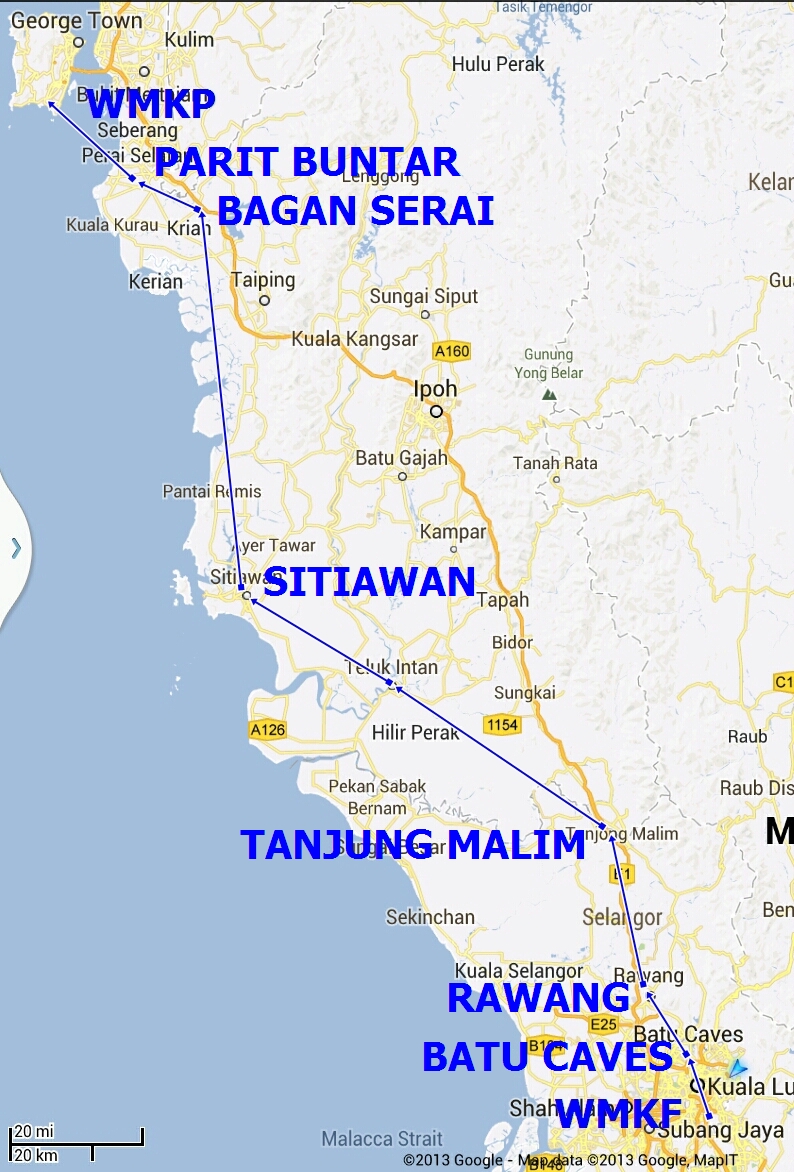
The first leg took us from Kuala
Lumpur to Penang, a two-hour flight at 4000ft and tracking via Batu Caves,
Rawang, Tg Malim, Teluk Intan, Sitiawan and Bagan Serai. Flying in company and
with weather being excellent, the three aircraft's crews and passengers had
spectacular views of the morning sun throwing its rays from the four o'clock
position onto the hills and plains to our left. As planned, we descended after
Bagan Serai for Penang International Airport where we landed one by one, refueled
and had some refreshments. As it was our point of exit from Malaysia, we went
through Customs and Immigration before taking off for our destination Phuket (it
is pronounced “poo kate’ and not with an F).


We took off in turn from
Runway 04 Penang, taking us over the city of Georgetown with its Komtar
building dominating the skyline and then the scenic beaches of Tanjung Bunga from
where we began our island hopping legs. After about forty minutes, Langkawi
Island appeared on the horizon like a legendary tropical isle. Overflying it,
we approached the international boundary further north into Thailand, an
airspace I had not flown in on my own before. From then on numerous islands of
varying sizes passed below us, each with its own white sandy beaches and rocky
outcrops. Among the larger islands were, as we flew northwards, Ko Tarutau, Ko
Ta Li Bong, Ko Lanta Yai, the two Ko Phi Phi's and Ko Yao Yai (“ko” means
island in the Thai language) before we swung left to Phuket airport. The most
spectacular was Big Phi Phi (Phi Phi Don) with its two crescent lagoons that
glimmered in the sunlight. The smaller Phi Phi Leh was more rocky but had
hidden beaches below the rocks and was the setting for both the movies
"Blue Lagoon" and "The Beach". I then realised how
fortunate I was to be able to have such magnificent views of the islands which
not many can have unless they fly that low.
Throughout the flight into
Thai airspace, the ATC service was excellent and we had not much difficulty in
communicating with the controllers. We were cleared for Runway 27 Phuket and
taxied down the long undulating runway to the parking ramp to the end on our
left. Immigration, customs and health checks proceeded without fuss and we were
soon on our way to our hotel on the touristy Patong beach.
The next morning, we
obtained clearance from the friendly ATC personnel to fly on a circuit around
the island at 1,000 feet and so all three aircraft took off on Runway 09,
turned right and began our clockwise journey over the several beautiful beaches
that ring the island. The flight was most exhilarating and soon we were back to
the airport for a landing. We stayed another night in Phuket partaking in the
delicious local cuisine and shopping for some clothing items.
Sunday morning came and it
was time to head for the airport for our return flight. Upon arrival, we filed
our flight plans and were told that we had to pay for parking and landing fees
which came to US$100 per aircraft. This was something we never expected as back
home this would have amounted to not more than US$5 per aircraft. In response
to our disbelief, the controller showed us their book of charges which
indicated a minimum of US$50 per night for aircraft of below a certain weight.
We sensed that the rate probably applied to commercial aircraft but we realised
that we had to go home and the argument was not going to be settled soon or in
our favour. We paid up after collecting cash from the team members.
Our ordeal had just begun.
With the receipt in my hand, we went through passport and customs checks.
Apparently immigration and customs officers on duty were working on overtime on
Sundays and needed to be paid. More cash was dispensed. Oh, they even issued us
receipts for these payments though we could not read what were written as there
were no English words on them.
As we walked across the ramp
to our aircraft, we requested for the fuel bowser to be sent round for
refueling. Again another ingenious response came . The bowser driver was at
home as it was a Sunday but he could be summoned to come over if we agreed to
pay his taxi fare and overtime. We suspected he was just lazing behind the
office building. More cash was dispensed. Finally we were airborne again over
the scenic Andaman Sea with its beautiful islands as we winged our way south
for home.
The episode did not end
then. Some weeks later we received an invoice from the Thai airport company
requesting for a further sum from us for "navigation charges" based
on the actual distances flown within Thai territory. I cannot recall the exact
sum but it was maybe another US$50 per aircraft. All the team members paid
their share as to act otherwise would mean putting our club on their blacklist and
causing future fly-in requests by our club members to be rejected.
Upon my return, I described
our experience to a senior club member who responded with his own story of how
he faced a similar situation in Kupang, Indonesia when he flew there in our
club aircraft a few years earlier. In his case, he was told that the airport
had not received the diplomatic clearance telex from their head office and that
he would not be allowed to take off until the receipt of that telex. After a
small payment, the telex was found in a desk drawer somewhere.
Despite the traps that may be
sprung upon a pilot landing his plane in a foreign country, the adventure
element in making a first flying visit to that destination may still goad him
to risk it. The satisfaction of seeing new places spread below one's eyes from
a thousand feet up and landing on foreign soil is irresistible.


