Wednesday, June 18, 2014

Building The F-86-F Sabre Plastic Model (Plasmo)

The F-86 Sabre jet fighter was built by North American Aviation in the late forties. In the Korean War (1950 - 1953) it was claimed to have shot down Mig15s with a kill ratio of 1.8 to1.  My interest in the aircraft started when in the late fifties the Royal Australian Air Force (RAAF) based two squadrons of the Australian-built version of the type at the air base next to my school in Butterworth . I saw the aircraft flying in, out of and around the school daily. On its base leg, the distance from a Sabre to me sitting in my classroom is so close that it fills up almost half the window. I could see the pilot turning his head in the half open cockpit. The interior of the sun-heated bubble cockpit was so hot that he slid back his canopy to let in some cool air. On one of the arranged school visits to the base, I was shown the cockpit controls and instruments. The memory lives on.

Fifty years later, I saw an Italieri plasmo kit in a hobby shop and decided that I must build one. The 1/32 scale was perfect as I already had a similar-scaled ready-built Messerschmitt Me262 Swallow in my "hangar". The two aircraft would make good size comparison. Below is a brief history of the construction process.

The last time I had built a plasmo was probably more than ten years ago. It was a 1/48 scale Airfix Panavia Tornado GR1 but I broke it when moving house. Brushes, paints and other equipment had long been disposed off, so I had to start buying afresh.

I opted for the F-86F-30 version depicting the aircraft known as "The Huff" flown by Lt. James Thompson of 39th Squadron operating in Suwon, Korea in 1953. A large dragon was painted on the right fuselage of his aircraft after he had shot down a MiG-15 which had a dragon painted on it.

THE BOX


THE INSTRUCTION BOOKLET


THE JET INTAKE TUNNEL

The right and left halves of the jetpipe were glued together, joint lines filled with putty and sanded smooth to hide the line.


UNDERWING FITTINGS AFTER PAINTING


FUSELAGE & ENGINE ATTACHMENTS


EJECTION SEAT & NOSE WEIGHT INSTALLED

Forty grams of nose weight are recommended


THE INSTRUMENT PANEL, JOYSTICK & RUDDER PEDALS ADDED

Note the weathering done on the seat and floor.


JETPIPE, WHEELS, MACHINE GUNS, ENGINE PARTS & SIDE CONSOLES PAINTED

The right and left halves of the jet exhaust pipe and compressor housing were glued together, the gaps filled with putty, sanded down to hide the line and painted. I had snipped off the axle for the nosewheel which I mistakenly thought was an injection channel, so now I had to glue the lower part of the nosewheel leg directly onto the side of the nosewheel with the hope that the assembly will later be able to take the aircraft's forward weight.


 THREE STARBOARD SIDE O.50" BROWNING M2 MACHINE GUNS

The pins behind the machine guns did not match the holes in the side panel. I had to truncate the rear part of the machine gun butts to align them.


PORT SIDE PANEL WITH THROTTLE LEVER


BOTH SIDE PANELS INSTALLED & INTAKE PIPE PAINTED


THE J47-GE-27 TURBOJET


FRONT VIEW OF THE ENGINE


CLOSE UP OF THE COMPRESSORS & COMBUSTION CHAMBERS


TOP & BOTTOM HALVES OF WINGS CEMENTED

I forgot to install the navigation lights in the wingtips, so I had to prise apart the two halves later on, inserted the nav lights and re-cement them.


RIGHT & LEFT REAR FUSELAGE HALVES CEMENTED

The inside surfaces were painted prior to joining. The joint line was filled with putty and sanded down to hide the line.


RIGHT & LEFT FORWARD FUSELAGE SHELLS CEMENTED

The joint line was filled with putty and sanded down to hide it. 


NOSE RING, SIDEWINDERS & TAILPLANES PAINTED


THE WING ASSEMBLY PRIOR TO PAINTING

The top and bottom wing halves were not properly aligned by me when cementing them together, causing obvious unevenness in the edges. I had to fill in the gaps and open ends with putty and then sand them down into smooth edges that leave no evidence of the joined halves. I left the flaps out at this stage to avoid them being detached accidentally when continuing to work on the wings.


NOSE INTAKE

After installing the nose ring, there were wide gaps in the joint and the inner wall of the nose was wider than the ring at the front. I used a lot of putty to smoothen the inside wall of the nose. Applying putty and then sanding down the wall was a difficult task due the restricted room available


.  FLAPS & DROP TANKS

The flaps and underwing drop tanks came in upper and lower halves. These were cemented, the gaps filled with putty and then sanded down to hide the joint lines.


THE SCRIBER

Because the sanding of the various surfaces had also removed the factory-engraved panel lines, I had to put the lines back by rescribing. There are many manufacturers of this tool. I bought mine from RB Productions in Ireland. 

PANEL LINES RESCRIBED


RIVET TOOL

Sanding down the model's surface also removes the rivets that hold aircraft skin panels in place. To put back these rivets onto the model, a rivet tool is used. It is just a wheel with sharp teeth on the edge that mark holes as the wheel is dragged in a line.


RIVET HOLES CREATED BY A RIVET TOOL

A poor job was done by me in restoring the rivet holes across the nose.


SIDEWINDERS & DROP TANKS WITH DECALS ON


SETTER & SOFTER

I have never tried the above products before, so it was a discovery indeed. The setter is applied on the surface where the decal will go. This is supposed to eliminate bubbles under the decal and also make the surface "suck" onto the botom of the decal. The softer is applied on top of the decal and softens it so that it will cling to the model's surface especially where there are indentations, protrusions, bends and corners. the result is that the decal will appear as if it was painted on rather than stuck on. When the softer is first applied, the decal will wrinkle considerably but after ten minutes or so it will shrink tight and blend with the surface.

To make the model appear more realistic, I decided to paint the aluminium panels in two different colours as seen below.


PAINTING THE CANOPY FRAME


THE MONTEX MASK INSTRUCTION SHEET


To paint the canopy frame in aluminium, I purchased a set of masks made specially for this model from A2Zee Models in UK. The self-adhesive masks are stuck onto the inner and outer surfaces of the canopy blocking the clear areas of the canopy from being painted on.


PAINTING THE INSIDE OF THE LEFT SPEED BRAKE COMPARTMENT


AND THE RIGHT


THE CANOPY & TURTLEDECK TOP PAINTED


REAR FUSELAGE DOLLY

The model comes with an option of separating the rear section for maintenance purposes. This requires that the section be mounted on a dolly. The dolly's parts are rather pliable, so I assembled them into two halves to achieve rigidity before painting and joining them together.


THE REAR SECTION WITH DECALS AFFIXED SITTING ON ITS DOLLY

The tailplanes' tabs were too thick for insertion into the slots on the fuselage. Having broken both in the process, I had to glue the tailplanes' inner edges flush with the fuselage sides, which then resulted in the dihedral angles being less than symmetrical. 


REAR VIEW OF EMPENNAGE


ANOTHER VIEW OF THE REAR SECTION


THE FRONT BULKHEAD OF THE REAR SECTION


OVERLAPPING DECALS

The wings were painted in different aluminium colours for realism. The yellow bands on the wings are decals that are too long. I failed to trim them to fit the wing chord as a result of which the ends overlap. Painting the black ends yellow did not work as the paint was of a darker yellow.


PATCHED YELLOW BAND

Patching the overlapping black area with parts of a decal meant for an alternative livery was the next best solution.


SIMILAR OVERLAP ON RIGHT WING


OVERLAP COVERED WITH PORTION OF SPARE DECAL 


"THE HUFF" DECAL APPLIED TO LEFT FUSELAGE

One thing I learned from this project is that it is better to cut long decals into short parts and apply them separately. The long ones tend to roll up into a mess or just tear off at the narrowest part when wet.

 DECALS APPLIED ON THE RIGHT FUSELAGE


UNDERWING DECALS & ATTACHMENTS

The underwing decals were applied before joining the wings to the fuselage. After that the flaps were installed and painted. Decals on the flaps were affixed and then the undercarriage were installed followed by the Sidewinders and drop tanks.


THE FUSELAGE YELLOW BAND

The yellow band circling the mid-fuselage actually straddles both the front and rear sections. The band decal however came in only one piece, unlike the speed brake decals which came in two parts for each side. I had to cut the decal into three sections - one for the front fuselage and two for the rear fuselage. It was not precisely done by me ending with the rear fuselage portions being not symmetrical. The cockpit canopy is now in place.

THE REAR ENDS OF THE FUSELAGE YELLOW BAND APPLIED


REAR VIEW OF THE FORWARD SECTION


CLOSEUP OF THE GUN COMPARTMENT WITH ITS COVER ON THE GROUND


CLOSEUP OF THE RIGHT MAIN UNDERCARRIAGE


CLOSEUP OF THE NOSE UNDERCARRIAGE


THE DRAGON, SIDEWINDER & DROP TANK ON THE LEFT SIDE


VIEW OF THE AIRCRAFT & ENGINE IN THE HANGAR


- END -


Monday, April 21, 2014

What Happens To Excess Carry-On Luggage

The piece below was taken from Avweb.com's April 21, 2014 issue. I witnessed a similar practice when boarding a low cost carrier's aircraft on a domestic flight not too long ago. It looked like it was standard practice with this airline. If you bring in one luggage too many into the cabin, you will probably see it dropped from the cabin door to the tarmac below for stowage into the cargo hold.


Air Canada says it will fire two baggage handlers caught on video dropping carry-on items from the top of a stairway into a bin 20 feet below last week. Passenger Dwayne Stewart shot the video last Thursday at Toronto's Pearson International Airport as he and his incredulous seatmate watched through the window. The flight was full and some passengers had been required to gate-check their carry-on luggage because the bins were full. Rather than carry the bags down a flight of stairs to the baggage cart, the two workers set up a relay with the ramp worker at the gate level tossing the bags into a bin where the second worker transferred them to the cart. Stewart told CBC News he and his seatmate at first didn't believe what they were seeing.
 "We were pretty shocked to see it happening. We actually laughed initially. We didn't think it was real," Stewart said. The baggage handler on the ground was not entirely without empathy for the fate of the contents of the freefalling bags. After several bags had tumbled onto those that had fallen before, the worker put a bunched up tarp in the bin to cushion the fall of the remaining bags. It probably won't be enough to save his job, however. Stewart, who was on his way home in British Columbia via Vancouver on the flight, posted the video, which has more than 500,000 views on YouTube. He said "embarrassed" Air Canada officials have contacted him saying their actions don't reflect the attitudes of the airline's other 27,000 employees. Air Canada issued a statement on Saturday confirming it is now in the process of identifying the workers so they can be given their walking papers.

Friday, March 14, 2014

Saving His Family Jewels From The Lion

Here's an entertaining story from a pilot in South Africa which I have extracted from the February issue of the Global Aviator:

There I was. What now?
by Gary Wiblin


I packed away the family jewels faster than the blink of an eye!

It was a gloomy morning as I took off from PE’s runway 26 and turned out right for a game farm called wandwe, just 30 or so minutes to the North of PE. I was to fetch a group of American tourists who had come to the end of their stay and needed to begin the long journey back to the USA. I was flying a Caravan C208B and I leveled off at flight level 070 and engaged the autopilot. 

This is always my favourite part of a charter flight, when I am alone in the aircraft and sitting in smooth conditions with the autopilot engaged. It is a time of reflection, a time to be fascinated by flight and grateful to be a professional pilot. I always love sitting up there in the sky, all on my own, in a multi million Rand machine, with everything purring just as it should, watching the world slide by below me. It is a feeling only we pilots know and we cherish it. 

All too soon it was time to begin descent into Kwandwe and I disengaged the autopilot and flew by hand until overhead the field to ascertain the wind direction. It looked like the Northerly runway was a good option and I flew the correct joining procedure to end up on final approach. It was then that I noticed a fully grown giraffe ambling out of the bush nearby. Dang. Would he remain clear of the runway or would he stroll in front of me? If he did stroll onto the runway, a go around would have to be executed rather smartly to gain sufficient height to avoid getting a giraffe head through the windshield. I decided to rather do a flyby and hopefully scare him off. This I did and when I had repositioned on final approach he was exactly where he had been before. A placid chap this giraffe was. In fact he was now noshing on some foliage near the edge of the runway and I decided to continue with the approach and landing and be on the alert for a go around at any time. 

All went well and my new tall friend never even glanced in my direction as I landed, turned around, and taxied to the concrete block that served as a dispersal area. All had gone well. Upon shutting down I opened the door and hopped down to the pavement. I was by this time dying for a pee so I strolled over to a bush about 100 metres away and began doing my business. I was about mid pee when I noticed that under another nearby tree there was a large male lion that was stirring
from his slumber and was now taking note of the new intruder on his territory. Well, I packed away the family jewels faster than the blink of an eye, covered the 100 metres in a flash and was up the Caravans ladder quicker than a jackrabbit. The door though was still chained open (a Caravan has an annoying system of keeping the pilots door open and if you forget to unhook the chain before entering the cockpit you need to exit again and unhook it). Double dang. I was now in the aircraft but with the door stuck open. The lion had by now sauntered a bit closer to take a closer look at his possible next meal and I sat rigid in the cockpit wondering what the heck to do next. Would he figure out how to hop up the stairs for a quick snack? I’ve never been so scared in my life. 

Thankfully he merely strolled around the aircraft, yawned loudly and sauntered off into the bush again and I lived to fly another day. The passengers soon arrived and I had to get out and pack all the baggage into the pod but I did feel a bit better knowing that the lion would now have a wider menu to choose from should he return for another look. And I was also now rather expeditious at climbing those stairs speedily. 

Thankfully the rangers were on hand to chase the offending creature with their vehicles and we soon got airborne and headed for PE where my pax would begin their journey back home.


The life of a charter pilot – it cannot be beat!

Sunday, December 8, 2013

A Hole In The Cloud

Fans of aerial combat will remember how Allied bombers over Germany looked for holes in the clouds to descend through and then looked for their targets. When flying in the early mornings,  I had to use the same technique to reach some destinations. This manoeuvre is not without its risks, so I avoid it as much as I can.
In the early nineties the GPS for aerial navigation was still an expensive equipment, costing more than RM4,000 each. We flew using only maps and the magnetic compass. As the latter swings erratically and takes a long time to stabilise whenever an aircraft changes direction, another instrument called the Directional Gyro Indicator (DGI) is used. This is a more reliable instrument but the pilot has to regularly feed in the headings that he reads from the magnetic compass into the DGI which always "drifts" as time passes.
I was flying from Sempang (the callsign for the RMAF base on Jalan Sungei Besi in Kuala Lumpur) to Taman Negara in Pahang one cool morning. Taman Negara happens to be my favourite weekend destination whenever I fly. It is only an hour's flight away and yet is a thick tropical jungle protected by law and had existed for 130 million years untouched by glaciers. It had clean rivers, cool waters and many rapids.
The sky was clear when we left. Our flight plan was filed for Batu Caves, Bentong, Jerantut and then Sungai Tiang which is the laterite airstrip located about five kilometres downstream from Kuala Tahan, our eventual destination. It is the site of most tourist amenities in the area. After Batu Caves,  we passed Genting Highlands on our left and was overhead Bentong airfield which in reality is a fairway on the Bentong golf course. Overflying Bentong at our cruising altitude of 3,000 feet,  we tracked direct for Jerantut which took us to the right of and below the peak of the majestic Gunung Benum. However we found that the cloud cover below us was thick and had blanketed the entire terrain ahead of us leaving no landmark for us to refer to. Jerantut was up ahead somewhere and we had to find it somehow since our subsequent leg to Sungai Tiang was by following the Pahang River northwards beginning from Jerantut.
We had an instrument on board called the Automatic Direction Finder (ADF) which can be used to track a radio signal from any radio station. This instrument is usually unreliable as it will point to any electrical source nearby such as a cloud with an electrical charge or some unknown radio transmission. Knowing that Jerantut has a radio broadcasing station, I tuned the ADF to the station's frequency but this time there was nothing heard and the needle pointer was rotating all over the gauge.
There was no other choice but to find a hole in the cloud below us and go down it to see what landmark lay below that we could recognise. Comparing our elapsed flight time and airspeed with our navigation log, we should have just passed Jerantut. Luck was with us and a reasonably sized hole in the white substance below us was nearby. We had to go through it quickly or it may close back leaving us stranded in the sky. The C172 is not a fighter plane that can zip down a hole just like that. I had no dive brakes. If I were to simply dive the plane through the hole, the gravity would accelerate it to a speed beyond its limit and rip its wings off. After checking with Air Traffic Control that no other traffic was nearby, I put the plane into a shallow spiral dive with twenty degrees flaps and kept the airspeed near the limit. Peeping through the hole I could see flat terrain below, so there was no danger of hitting a  hill or something.
After what felt like hours, we finally were below the cloud which was just a thousand feet above the ground. Visibility was good. I looked around and saw a river not far off, headed towards it and from its size knew that it was the right river although Jerantut was nowhere to be seen. We headed north along it confirming the layout with that on our map. Further upriver there were familiar-looking boats that added to my confidence that we were at the right river. Taking the correct forks as we flew on, we finally saw the Sungai Tiang airstrip and landed.


I locked the plane up and we walked to the jetty to wave down a boat, as I used to do, to take us on a one and a half hour ride to Kuala Tahan. The cool breeze that blew as the open boat trundled through the rapids was very welcome indeed (the normal passenger boats usually have a canopy above to ward off the sun).

We lunched at the usual cafe, walked around and then took another boat back to the airfield.  This time the warming earth had pushed the morning's cloud layer up a couple of thousand feet to form fast growing cumulus hills that will not only affect our visibility but also make the flight home a bumpy one.

Monday, October 28, 2013

The Red Bull Air Race Returns

The last Red Bull Air Race (RBAR) was held at the EuroSpeedway racetrack in Lausitz, Germany on August 8, 2010. The race was won by Hannes Arch but the season's championship went to Paul Bonhomme who scored 64 against Arch's 60 points. Arch won 4 races and Bonhomme 2 in the 6-race 2010 season.

I thought that was the last we would hear of the RBAR but now I am overjoyed that it is starting again in 2014 and the icing on the cake is that the second race of the season will be held in Putrajaya, practically on my doorsteps. Hopefully I can shoot some nice videos of thr race myself. Below is my collection of videos that I purchased off the net and which covered previous RBARs.


For 2014, I am counting on Arch to be the champion as his performance since his first participation in 2007 has been impressive. He won in 2008 and was second in 2009 and 2010.

Monday, July 22, 2013

Fly-In To Phuket

Fly-Ins are always fun and I decided to organise one in November of 1988 but with a big difference. The destination was to be in a neighbouring country, Thailand, which I had never flown to in a light aircraft before. It turned out to be most enjoyable but at the same time it put the travelers through some unsavoury experience.

Having no experience in such undertakings, I consulted those who had made cross border flights before and began by applying through our Malaysian Foreign Ministry for a diplomatic clearance by the Thai authorities. This was done two months ahead of the event and after I had made all the interested participants place sufficient funds with my flying club to cover the aircraft rental and fuel expenses. The aircraft particulars, route details as well as the names and passport numbers of the pilots and passengers were furnished together with the application.

One week before our departure date, I enquired from the Foreign Ministry about the Diplomatic Clearance and was told that no news had been received from Thailand. I then visited the local Thai Embassy and was advised to pursue the matter with our Foreign Ministry as our application was made there and not through them. I called the Ministry daily until the day before our scheduled departure. On the eve of our departure at 6.00pm a call came from the Ministry with the Diplomatic Clearance number. I immediately filed the flight plan with the control tower quoting the reference number. All the group members were already on tenterhooks by then as it had been a long wait without any indication that the fly-in would materialise.

We had only two C172s available and had to turn away many members. Only those who paid first were given places. I however managed to rent a PA22 from a flight training school on condition the aircraft PIC was an instructor from the same school and that we would bear his lodging expenses. I agreed to this and we therefore were able to accommodate three more individuals excluding the pilot into the party.


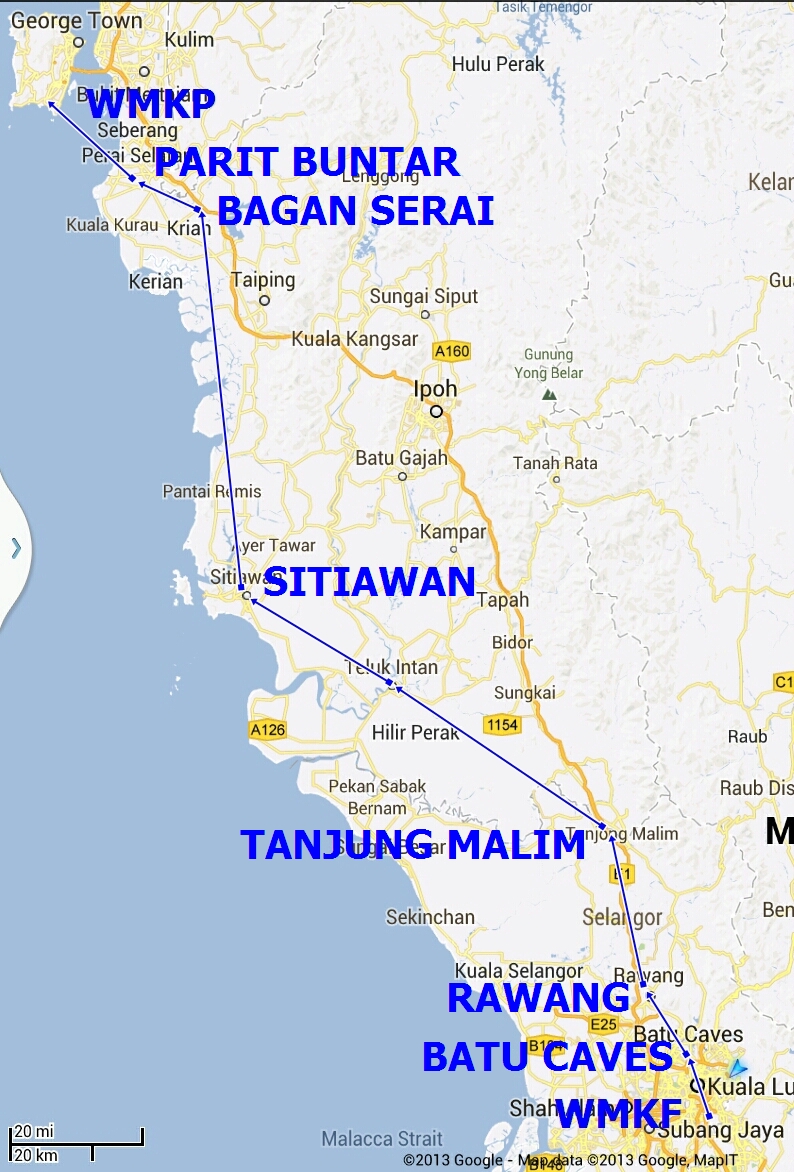
The first leg took us from Kuala Lumpur to Penang, a two-hour flight at 4000ft and tracking via Batu Caves, Rawang, Tg Malim, Teluk Intan, Sitiawan and Bagan Serai. Flying in company and with weather being excellent, the three aircraft's crews and passengers had spectacular views of the morning sun throwing its rays from the four o'clock position onto the hills and plains to our left. As planned, we descended after Bagan Serai for Penang International Airport where we landed one by one, refueled and had some refreshments. As it was our point of exit from Malaysia, we went through Customs and Immigration before taking off for our destination Phuket (it is pronounced “poo kate’ and not with an F).


We took off in turn from Runway 04 Penang, taking us over the city of Georgetown with its Komtar building dominating the skyline and then the scenic beaches of Tanjung Bunga from where we began our island hopping legs. After about forty minutes, Langkawi Island appeared on the horizon like a legendary tropical isle. Overflying it, we approached the international boundary further north into Thailand, an airspace I had not flown in on my own before. From then on numerous islands of varying sizes passed below us, each with its own white sandy beaches and rocky outcrops. Among the larger islands were, as we flew northwards, Ko Tarutau, Ko Ta Li Bong, Ko Lanta Yai, the two Ko Phi Phi's and Ko Yao Yai (“ko” means island in the Thai language) before we swung left to Phuket airport. The most spectacular was Big Phi Phi (Phi Phi Don) with its two crescent lagoons that glimmered in the sunlight. The smaller Phi Phi Leh was more rocky but had hidden beaches below the rocks and was the setting for both the movies "Blue Lagoon" and "The Beach". I then realised how fortunate I was to be able to have such magnificent views of the islands which not many can have unless they fly that low.

Throughout the flight into Thai airspace, the ATC service was excellent and we had not much difficulty in communicating with the controllers. We were cleared for Runway 27 Phuket and taxied down the long undulating runway to the parking ramp to the end on our left. Immigration, customs and health checks proceeded without fuss and we were soon on our way to our hotel on the touristy Patong beach.

The next morning, we obtained clearance from the friendly ATC personnel to fly on a circuit around the island at 1,000 feet and so all three aircraft took off on Runway 09, turned right and began our clockwise journey over the several beautiful beaches that ring the island. The flight was most exhilarating and soon we were back to the airport for a landing. We stayed another night in Phuket partaking in the delicious local cuisine and shopping for some clothing items.

Sunday morning came and it was time to head for the airport for our return flight. Upon arrival, we filed our flight plans and were told that we had to pay for parking and landing fees which came to US$100 per aircraft. This was something we never expected as back home this would have amounted to not more than US$5 per aircraft. In response to our disbelief, the controller showed us their book of charges which indicated a minimum of US$50 per night for aircraft of below a certain weight. We sensed that the rate probably applied to commercial aircraft but we realised that we had to go home and the argument was not going to be settled soon or in our favour. We paid up after collecting cash from the team members.

Our ordeal had just begun. With the receipt in my hand, we went through passport and customs checks. Apparently immigration and customs officers on duty were working on overtime on Sundays and needed to be paid. More cash was dispensed. Oh, they even issued us receipts for these payments though we could not read what were written as there were no English words on them.

As we walked across the ramp to our aircraft, we requested for the fuel bowser to be sent round for refueling. Again another ingenious response came . The bowser driver was at home as it was a Sunday but he could be summoned to come over if we agreed to pay his taxi fare and overtime. We suspected he was just lazing behind the office building. More cash was dispensed. Finally we were airborne again over the scenic Andaman Sea with its beautiful islands as we winged our way south for home.

The episode did not end then. Some weeks later we received an invoice from the Thai airport company requesting for a further sum from us for "navigation charges" based on the actual distances flown within Thai territory. I cannot recall the exact sum but it was maybe another US$50 per aircraft. All the team members paid their share as to act otherwise would mean putting our club on their blacklist and causing future fly-in requests by our club members to be rejected.

Upon my return, I described our experience to a senior club member who responded with his own story of how he faced a similar situation in Kupang, Indonesia when he flew there in our club aircraft a few years earlier. In his case, he was told that the airport had not received the diplomatic clearance telex from their head office and that he would not be allowed to take off until the receipt of that telex. After a small payment, the telex was found in a desk drawer somewhere.


Despite the traps that may be sprung upon a pilot landing his plane in a foreign country, the adventure element in making a first flying visit to that destination may still goad him to risk it. The satisfaction of seeing new places spread below one's eyes from a thousand feet up and landing on foreign soil is irresistible.