Sunday, May 12, 2013

Learning From The Instructors


As I reminisce, it seems that a lot had been added to my collection of flying techniques since the day I had my first lesson. Yet I find that the most critical and useful techniques were actually taught me during the first fifty hours of flying. For this I have my instructors to thank for. I was lucky to have had two highly competent individuals as my mentors.

The first was Manjit. He was a tall handsome young man who was collecting his hours before he could join the airlines. He was methodical in presenting his preflight brief and would ask me quick questions on the aircraft as we walked to it, inside it and later as we walked back for our debriefs. Questions could vary from how much fuel could the tanks take to why the wings wash out at the tips. In the air he would ask if the engine would cut out if he switched off the ignition, and then as I said yes, proceeded to actually switch it off. Manjit led me to my solo by which time I had the answers to most, if not all, the questions.

After soloing, another instructor took over my training. Chandran was a QFI (Qualified Flying Instructor) and was quite elderly with an above average girth. He was soft-spoken and a man of few words. If he ever raised his voice, it would be a scream to get me to add power when we were sinking too fast or to go around when we were too high or in such similar situations.

Like Manjit did, Chandran too made me master the mnemonics which remain with me till today. From HASELL to TVMDC, the mnemonics will never be forgotten and have been found to be useful in times of need.

Chandran had these tricks and formulae to make complex procedures simple. With short and sharp instructions, he would guide me as to what the requirements are for, say, a good approach. "Before base speed 80kts, flaps one, speed 70kts, turn base and descend....turn to final to complete by 300ft AGL, flaps two...speed 65kts, descent rate 200fpm..." and on he went. Most of the time his formulae worked and I lived by them.

One of my favourite destinations was Tioman Island less than two hours flying time away from my base. Although exotic in itself (the island “Bali Hai” in the musical movie “South Pacific” is in real life that island), the attraction to pilots is because its 900-metre runway is enclosed on three sides by steep hill slopes and the fourth side by the sea.

APPROACHING FROM THE WEST


Only pilots checked out on the airport by an instructor are allowed to land there. Chandran had a simple formula for landing there – establish right base at 300ft AGL on feet dry, cling close to the hill on the left while descending, turn final and select full flaps while skimming the grove of coconut palms that stretch to the runway’s edge, then when clear of the palms, cut power completely, push the aircraft down to the runway and ensure that it drops on its main wheels carrier-style. “Don’t worry,” he said, “the Cessna’s main undercarriage is made for heavy landings.”  In later years, the runway was lengthened and the palms on the approach cleared away.

CHANDRAN'S FORMULA
(AFTER RUNWAY EXTENSION)


EARLY BASE VIEW
(BEFORE RUNWAY EXTENSION)
Wikipedia

I have never had any problem landing at the island despite tailwinds sometimes and I owe one to Chandran. As I continued flying over the years, Manjit’s and Chandran’s words constantly echoed in my head guiding me to do the right things as the situations demanded.

Saturday, April 27, 2013

The Wonder of Cassini-Huygens' Voyage to Titan

This is not exactly an aviation story but I apologise for the diversion. The significance of the event that I am about to describe is as great as man's first flight in 1903. The Apollo manned landings on the moon and the successful return of the space travellers to earth are by themselves  some of man's greatest feats. The work now being carried out by the Mars Exploration Rover on that planet's surface is yet another major achievement.

I am however very much impressed with the journey and landing of the Cassini-Huygens (CH) spacecraft on Titan, which is Saturn's largest moon. The distance between earth and Saturn is about 1.4 billion kilometres. It took CH seven years to reach Titan. For this to happen the planets have to be ideally aligned so that CH can use the gravitational slingshot effects of earth, Venus, Jupiter and Saturn to reach Titan with the fuel that was available on board. Man would have to wait another 600 years for this alignment to occur again!


What is so interesting about Titan? It is a cloud-shrouded moon which means it is somewhat like earth but scientists want to know what its surface is like underneath the thick red clouds which are mainly composed of nitrogen and some methane Scientists believe the reddish colour of the clouds come from a substance called tholin.. There is no oxygen on Titan thus precluding man from inhabiting it. Gravity on Titan is about one-sixth that of earth but the atmospheric pressure on its surface is 1.4 times that of earth due to the thick opaque clouds that hide its surface from us.

Huygens, the lander module of CH, has succesfully sent us images and data about Titan's surface. It is almost earth-like but due to the extremely cold temperatures, all water is frozen. Rivers abound but they are not of water, rather the fluid is liquid methane since methane has a much lower freezing point. Liquid methane flows from rivers into lakes but there are only a few lakes on Titan. Past erosion by these methane rivers have created canyons and valleys not unlike what is seen in Arizona.

There are also "volcanoes" on Titan but they spew "lava" consisting of water and ammonia which flow down the slopes. Because of the cold nature of the flows these "volcanoes" are called cryovolcanoes. Other surface features of Titan include craters created by the impact of objects from space but these are few. 

What about the surface material on Titan? Huygens' instruments and cameras show that the landing site is made of sand, pebbles and small rocks which are basically ice.

Wednesday, February 13, 2013

TRIBUTE TO THE LATE COL. (Rtd) ZAKARIA SALLEH


The late Col. Zakaria Salleh (whom everyone called Zak) was a small-built pilot but his aerial exploits and the significant contributions he made to general aviation in Southeast Asia was legendary.

I first met Zak when he was teaching several of us to fly the Quicksilver ultralight during his spare time. We were flying at various open spaces which were pending development and as soon as construction work started at these sites, we had to move like nomads to new flying sites. At that time Zak held the rank of Flying Officer in the air force and was flying F5 jet fighters. I then lost touch with him as I progressed to Cessnas and flew at proper airfields.

Several years later, Zak started instructing at the Royal Selangor Flying Club where I was regularly flying from. He was ater elected the Club Captain and was responsible for all flying activities of the club. In this role he organised regular fly-ins, open days, flying competitions and air shows. I enjoyed participating in most of these events which took us to various airports and airstrips not only within Malaysia but also in the neighbouring countries.


A FLY-IN TO PESTA LUMUT IN 1991
Zak is circled  The writer is second from left.
Subsequently Zak retired from the air force with the rank of Colonel and having flown various fighter types like the CL-41G Tutor, Northrop F5 and A4 Skyhawk. He then flew target tugs and later several bizjets for a living. His flying and organising skills were recognised and he was subsequently elected as President of the Malaysian Sports Aviation Federation which is the umbrella organisation for all sports aviation related bodies in the country.

Zak loved aerobatics and formation flying and would put on impressive flying maneouvres at various air shows in the region. He was most famous for leading the Eagle 150 Aerobatic Team which regularly took part in the country's Independence Day parade flypasts and in air shows overseas. On occasions where the Eagle aircraft were not available, he would call up several pilots from various flying clubs and still put on a commendable performance. I was glad to join in and fly on some of these events.


PILOTS AFTER A FORMATION FLIGHT
(Zak is circled. The writer is second from right)

The Eagle 150 was a highly aerobatic aircraft and in the hands of someone like Zak, it was capable of some magnificient stunts that never failed to impress crowds. Zak, however, yearned for more. He went out and bought a dedicated aerobatic aircraft, the Christen Eagle, from the US. This was the aircraft he loved and with it he went on to mesmerise the crowds with his superb flying skills.


A CHRISTEN EAGLE AEROBATIC AIRCRAFT
(Wikipedia)

On June 23, 2011, while performing aerobatics in front of an air show crowd in Padang, Indonesia, his Christen Eagle slid down from a vertical climb and crashed to the ground. His wife, Leila, was watching from the stands. Zak passed away in hospital shortly after.


ZAK LEADING HIS EAGLE 150 OUT OF A HANGAR IN PEKANBARU AIRPORT

To Leila and the family, I send my deepest condolence. Zak was a good friend and helpful at all times especially in my flying activities. He is well-known in the flying fraternity in Malaysia as well as in the neghbouring countries. We shall always remember him.

Friday, January 18, 2013

A Vulcan Bombed Port Stanley Airport

Just saw a video on YouTube about the bombing of Port Stanley airport in the Falklands by a single Avro Vulcan V-bomber during the British-Argentinian war over the islands in 1982. The Americans would have turned it into a Hollywood blockbuster but the British just made it into a TV documentary but it sure had all the elements of a thriller such as the longest bombing run in history, a return-to-base by a back-up bomber due to loss of pressurisation, a fuel shortfall that meant being unable to reach home, mid-air refeelling in a thunderstorm, a 300ft AGL approach towards the target area and lots more.

The crew members of the mission were the "actors" and most of the shots were actual scenes during the war. It is heartwarming to see the survivors recalling the moments 30 years after the event.

Of course, what grab me are the live shots of the Vulcans and Victors which I have written about in another post (RAAF Butterworth) in this blog.

Go to XM607 - Falklands' Most Daring Raid and enjoy the show.

Saturday, September 29, 2012

RAAF Butterworth

The Royal Australian Air Force (RAAF) Base in the town of Butterworth, Malaysia was a military airbase run by the RAAF and is currently a Royal Malaysian Air Force (TUDM) Station after it was handed back to the Malaysian government in 1988. The history of the base goes back to 1941 when the  British colonial government set up the Royal Air Force (RAF) Station there to defend the then British Peninsular Malaya from the looming threat of invasion by the Japanese Imperial Forces at the advent of WWII.

THE BUS RIDE
My interest in that airfield was ignited from a bus ride which I took as a young boy from Kangar, Perlis back home to Butterworth in the mid-50's. At that time the airfield's only runway ran from the west starting from the beach facing Penang Island to the east overlooking the lush padi fields of Sungai Dua. The north-south road from Kangar in the north to the town of Butterworth crossed the airfield's runway about half a kilometer from the beach. So when an aircraft took off or landed, traffic on the road was stopped on both sides of the runway giving the bus passengers a grand view of all the aircraft movements on the runway. 

STOPPING NORTH OF RUNWAY (circa 1950's)
Photo by James Justice

I knew nothing about planes then, so it is now impossible for me to  say for certain what those jets were. The jets had taxied from my left, crossed the road we were on, made a U-turn at the runway end on my right and either proceeded to take off to the left or entered their dispersal area in that direction. The jet sound was loud and whiny typical of early generation jets, the markings were bold and colourful, the aircraft's base colour was metallic blue, the aircraft sat low on the ground and there were two pilots in flight overalls and flying helmets in each aircraft. They looked like the T37 "Tweetie Birds" one sees in the web pages and could have been the De Havilland Venoms. The image and the sound are still fresh in my mind today after more than 57 years!

A SCHOOL BESIDE AN AIRBASE
In 1959 I entered secondary school and it was a brand new school with me as one of its first students ever. There was a new runway being used (36/18) which was much longer than the west-east runway that I saw some years before. That former runway was put out of use after the new runway was completed. Situated less than a kilometer southwest of this new runway's 36 end, we had a good view of the threshold through the coconut palms that surrounded that part of the airfield. I presume that most of the flights started from that end as I was yet to see aircraft taking off in the direction of my school. With the jet nozzles pointing south towards my school, each takeoff is an aural experience hard to forget and the teacher had to stop speaking while all eyes would be on the runway until all the aircraft had taken off. We got used to the jet blasts after a while and no longer deemed them a nuisance.

TUDM STATION BUTTERWORTH
Google Earth Image

SABRES
From our playing field, we would see the Sabres (actually Rolls Royce-powered Commonwealth CA27 Sabres) making their rectangular left-handed circuits by first passing between us and the Runway 36 on our right, turning crosswind in front of us, then downwind to our left and curving behind us to land back to our right. The Sabres would usually fly in a right echelon of four with each one peeling off after another to enter crosswind.

CA27 SABRE
Wikipedia

Looking south from our classroom we would see the Sabres one by one curving in to land, each one filling up almost a third of our glass-louvred classroom window. The speed brakes and landing gear would be already extended and sometimes the bubble canopy would be pushed back slightly to let some fresh air in (imagine one being fully clothed and helmeted with the oxygen mask covering most of one's face and the baking sun piercing the clear canopy). More often than not, the pilot would add in a bit of power to reduce his descent rate right in front of our class window and we just loved hearing the sweet hiss-whine-roar of the turbines spooling up. That scene is certainly unforgettable and we got to see it every school day.

CANBERRAS
The next most common aircraft were the English Electric Canberras which I noticed were of two types - the reconnaisance version (PR7) with a clear perspex nose and the bomber version (B1) without it. I remember that there was a red lightning logo on the tail which could well be the squadron emblem. The Canberra had two of the Sabre's engines, so even without looking up I could always tell whether it was the Sabre or the Canberra that was flying up there. Being bulkier and a bomber at that, the Canberra was never seen doing circuits but perhaps they did do circuits. Maybe the circuit legs were too far out for us kids to see.

CANBERRA B2
Wikipedia

TRANSPORTS
Among the cargo/passenger aircraft operating from the base were some DC3 Dakotas, the wide bellied Vickers Valettas (one can be seen in the first photo above) and a later addition, the Lockheed C130 Hercules (which marked the end of the radial engined aircraft like the DC3s and Valettas). While the DC3 and Valetta's huge engines shook the ground and shattered the air with their deep throated exhaust sounds, the C130's four turbines emitted equally loud whines which blended with the sound-barrier-breaking propeller tips' blasts to rattle the ground.

HELICOPTERS
Here again I witnessed the transition from piston to turboshaft engines. In the late 50's there were the Westland S55 Whirlwinds which were later replaced by the Bristol Sycamores. Both types had piston engines and were probably RAF rather than RAAF (though I may be wrong here).  They were all completely yellow, which I believe was the colour of search and rescue (SAR) aircraft. I was told that some Whirlwinds were also based atop Penang Hill. The Whirlwind was what I believed a helicopter should look like but the Sycamore when squatting on the ground looked like someone had bent its tail down in anger.
WESTLAND WHIRLWIND
Wikipedia

BRISTOL SYCAMORE
aviastar.org


In the early 60's I began to see the RAAF Bell UH-1 Iroquois replacing the Sycamores. The UH-1 was the iconic helicopter used in the Vietnam war where it was called "Huey". Using a powerful turboshaft engine and a two-blade rotor, the aircraft was painted a dark brown making it look vicious.  The whine and roar from the engine was typical of turbine engines but there were another two sounds to it that make this my favourite helicopter sound. One was the deep motorcycle-like throb and the other the "whupp, whupp" of the long rotor blades as they cut through the air.

RAAF BELL UH-1
pacificaces.0catch.com


OTHER RESIDENTS
Until the early 60's I could see both RAF and RAAF aircraft stationed there. The Valettas were certainly British as well as a few of the DC3s and C130s. Other resident aircraft that were probably used for currency checks for desk-bound pilots included the De Havilland Vampire and the Bell 47 helicopter.

VAMPIRE
www.whiteplanes.com


 BELL 47
Wikipedia


VISITORS
From the late 50's to the early 60's I had the privilege of seeing various visiting aircraft to the base. They either flew in from foreign bases of the RAF, from RAAF's Australian bases or from aircraft carriers of the Royal Navy that quite frequently sailed through the Malacca Straits. Some would stay for just a week or two while some would remain for a few months. 

From the RAF, there were the Gloster Meteors, the Gloster Javelins, the long-nosed Armstrong-Whitworth Meteor night fighters and the V-Bombers. The Meteor was good-looking with oversized engine nacelles and a rounded tailfin/rudder assembly. The Rolls Royce Derwent engines produced a pleasant high-pitched "groan" that was softer than the ghostly sound of the Vampire's single Goblin engine. The long-nosed Meteor, resembling the Canadian CF100 Canuck, had night radar equipment housed in its nose and looked quite different from the day fighter version though it used the same engines. They were later replaced by the delta-winged Gloster Javelin all-weather interceptors, each powered by two loud Armstrong-Siddeley Sapphire engines that pounded the runway on takeoffs.

GLOSTER JAVELIN
Wikipedia

The V-Bombers were huge but shapely jet bombers and were all-white in colour though in the later years they sported camouflaged upper surfaces. Their designs were ahead of their time, the Valiant being swept-winged, the Victor crescent-winged and the Vulcan delta-winged.

AVRO VULCAN, VICKERS VALIANT AND HANDLEY PAGE VICTOR
(from bottom to top)
www.probuspontivyfr.org

They were based in Butterworth during the Indonesian Confrontation period (1962-1966) and could have been significant players in keeping the Indonesia forces at bay. During one of our school's conducted tours of the base, I had a close look at the Victor and managed to catch a glimpse of the inside of its cockpit as its door was open. It was very impressive indeed.

Two other interesting visitors from the RAF were the really huge four-engined Blackburn Beverly and the dual-rotored Westland Belvedere helicopter. The Beverly had 18-cylinder radial piston engines that were absolutely loud and the top of its tail was a couple of stories high..

The Royal Navy aircraft were spectacular to say the least. My first view of a carrier-based fighter was of the De Havilland Sea Venom which probably flew in from the carrier "Ark Royal" that frequented Penang a few times in those days. It resembled the Vampire in shape but was slightly larger, had a crew of two and was powered by a De Havilland Ghost engine. My classmates and I used to wait among the bushes fringing the runway's 18 end immediately after school just to watch the Venoms land from the 36 end, made U-turns and taxied back in front of us to their dispersal. The crews would open their canopies and wave to us as they taxied by.

Another spectacular naval aircraft was the Supermarine Scimitar which always approached with an unusually high angle of attack looking like it was standing on its tail. This of course required a high power setting, the two Rolls Royce Avons producing a very loud blast that was audible a couple of miles away.

SUPERMARINE SCIMITARS
Wikipedia

One interesting visitor from a carrier was the Fairey Gannet antisubmarine aircraft. A fat-bodied fairly large aircraft, it had a set of two contra rotating propellers mounted on a single shaft that extended in front of its twin turboprop Hawker Siddeley Double Mamba engines producing a unique whine and roar. Another of its unique features was the huge radome under the nose which probably housed its sonar and radar equipment.

FAIRY GANNET
Gatwick Aviation Museum

There were two aircraft types that were used by the RAF during that period which I never got to see flying, even though at least one type was actually based in neighbouring Singapore. They were the sleek and beautiful Hawker Hunter and the ultrafast English Electric Lightning. However I did manage to get a close look at the Lightning seven years later at the Farborough Air Show and the Hunter at one of the museums somewhere else.

The Vietnam War was at its peak in the 60's and a few US military aircraft did make visits to Butterworth, apparently moving casualties out of the war zone. I saw some C74 Globemasters which were huge four-engined turboprop transports and to my delight some F105 Thunderchiefs which were fast and awesome looking fighter-bombers that liked to fly low above the airfield (one of them did an impressive vertical climb right in front of my eyes). One aircraft which I would have liked to see was the CH-47 Chinook dual-rotor helicopter.

BASE VISITS & AIR SHOWS
For a couple of years the RAF and RAAF opened their doors annually to visitors with static and flying displays of their aircraft. These had a big influence on me and made me want to be a fighter pilot. The RAAF had an aerobatic team of Sabres which performed quite impressively at these shows. Our school also had close links with the base authorities and we used to go and swim at the base pool every Wednesday morning.  There was also an occasion when we kids were taken on a conducted tour of the base. Besides walking around a Victor strategic bomber and a Vampire, I also had a chance to inspect the cockpit of a Sabre jet.

REPLACEMENTS
After 1963, I had to move away from Butterworth and lost touch with the movement of aircraft at the base. However, I knew that the Sabres and Canberras had been replaced with the RAAF's Dassault Mirage IIIs.

In the mid-70's I was posted to Penang and by coincidence handled the banking account of the RAAF Butterworth. Once a week I would travel to the base to attend to their banking needs. Once I was driven within sight of the long row of Mirages parked to the left of Runway 36. That was the first time I saw the aircraft. There were a few people I dealt with then and I remember some of the civilian officers as Jim Sweeney and a certain Mr Prowse. There was also a handsome Squadron Leader by the name of Jim Dickson. In fact they even had me in their homes during Christmas.

On one occasion, I saw a visiting RAAF F-111 Aardvark swing-wing bomber beating the base up at just above the flagpole that stood near the main gate of the base. The pole actually swung from the downwash off the aircraft's extended wings.

By that time, the Royal Malaysian Air Force (TUDM) was already sharing the base with the RAAF and was operating the Northprop F5E twin-engined jet fighters as well as some of the former RAAF Sabres donated by the Australian government. The RAF had completely evacuated some time earlier. Today the base is solely occupied by the TUDM as a station and is the home of its BAE Hawks, Aermacchi MB339s. Sikorsky S61s, Northrop F5Es and Boeing F/A-18D Hornets.

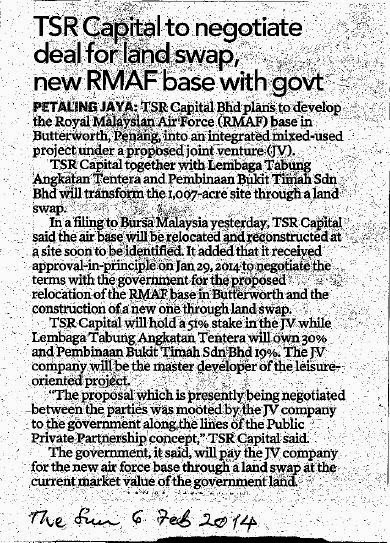
P.S. A sad development reported in The Sun on 6 February 2014:


Friday, August 17, 2012

Crosswind Landings and A Surprise 35-knot Headwind

WEATHER

Malaysia is considered a mild climate country as there is no extreme temperature. Most of the time it lies between 28C to 33C in the afternoon with a drop of about 3C in the early morning in the lowlands where most people live. Similarly winds in Malaysia rarely reach above 20 knots, so pilots generally have little experience in handling strong crosswinds during landing. For mild crosswinds, some training in crabbing and sideslipping techniques for landing is usually made mandatory  .

LANDING TECHNIQUES

In the former, the nose of the aircraft is deliberately pointed at an angle into the wind to counteract the otherwise sideways drift leewards. So, instead of pointing straight towards the runway, the aircraft is "crabbed" towards it. Moments before the wheels touch the runway, the nose is swung back to align with the centreline on the runway so that the wheels will roll forward as normal and not be dragged sideways causing the aircraft to skip or even topple on its side.

The latter technique involves lowering the windward wing while keeping the nose pointed straight towards the runway. The resulting sideways lift of the wings will counteract the otherwise leeward drift. The disadvantage of this technique is that the plane will sink faster towards the ground as the wings' vertical lift is now reduced by its sideways component which was created by banking the wings windward. The advantage of this technique, however, is that one can come in higher than normal and still be able to land on the threshold (a spot just after the edge of the runway marked with white stripes nicknamed "piano keys").

I have occasionally used both techniques over the course of my flying years but there was one instance when I could not use them and had to quickly devise my own technique. This was because this time the wind was coming from the front at about a 15-degree tangence  but the wind speed was 35 knots!

THUNDERSTORM

Here is how it all started. It was a bright day and I thought I would put in a half-hour to one-hour flight within the training area called R218. This area is a reasonably wide corridor that lies roughly between Kajang (2 minutes away from Sempang, our home airfield) and Semenyih. It has an upper limit of 2,500 feet and is used for training purposes as well as a transit lane for flights to and from the south. I scanned the sky before preflighting the aircraft and noted some rain clouds in the distance over Subang 6 miles away. They did not look threatening at all.

After obtaining Air Traffic Control (ATC) clearances, I took off and practised some manoeuvres within the training area. After about 30 minutes, ATC radioed me that the weather was closing in on the airfield and I was advised to return to base. As I neared Bukit Besi overlooking the airfield, there was a huge dark cloud hanging right on top of the runway and ATC advised that I was cleared to land with the surface wind indicating 200 degrees at 35 knots. Never had I heard such a strong wind from any ATC before but I believed it because that huge cumulonimbus cloud had a base at only around 2,000 feet. I could see the trees around the airfield swaying wildly. ATC then came on with a polite question "Do you need any assistance?" which they always say when they think a pilot or an aircraft might be in trouble.

LANDING

I assessed the situation as I turned right to join downwind at 1,000 feet for a left-handed pattern for Runway 22. With the wind almost head on at 35 knots and my normal final approach speed at 60 knots, my airspeed would show 95 knots when I touch down but the ground speed would be just 60 knots. This could not be the usual landing using flaps anymore as the flap limiting speed is only 80 knots and an airspeed of 95 knots might just rip them off. A flapless approach at an airspeed of 105 knots (normal flapless approach is at 70 knots) would just do the job, so I told ATC "Final, no flaps" which he acknowledged. By that time the sky had opened up and heavy rain was pouring on the aircraft and the airfield. It was a totally new experience for me to see the Airspeed Indicator (ASI) showing more than 100 knots as I touched down smoothly without flaps. All my previous no-flap landings over the years had not more than 70 knots or thereabouts on the ASI, so it was hard to believe that I was doing what I did as I descended the last 300 feet onto the runway and rolled out. The arithmetic has once again been proven - 105 knots on the ASI with a 35-knot headwind is equal to a 70-knot landing.

PARKING IN THE WATER

I thanked the ATC as I taxied into the ramp and stopped the aircraft. Another problem had however just cropped up. There was no umbrella in the plane and there was no way I could run into the hangar without getting drenched to the skin. So I waited it out in the cockpit for about half an hour before the rain finally eased. By then the aircraft's wheels were totally submerged in water. I removed my shoes and socks, rolled up my pant legs and waded to the hangar. So much for the Malaysian weather, a short flight in a bright sky can turn into a freaking thunderstorm and flooding in less than 45 minutes.

Monday, August 13, 2012

The Annual Haze (meaning Smoke)

Every year during the dry season West Peninsular Malaysia is covered with a blanket of smoke which the press strangely calls haze. This affects air traffic especially the smaller aircraft which do not have sophisticated navigation equipment. However the worst effect of the smoke is on health with many asthmatic and other lung ailment sufferers heading to hospitals for treatment. The smoke gets worse if no rain occurs.


SMOKE ENGULFS KL'S GOLDEN TRIANGLE

What is the cause of the smoke?

Sometimes it is the palm oil mills within the country itself that burn palm oil husk as fuel to sterilize the fresh fruit bunches in the process of manufacturing crude palm oil. Having flown over many parts of the country at a few thousand feet above the ground, I have witnessed extensive pollution of the air from these mills especially on flights between KL and Melaka and between KL and Ipoh. In Melaka especially, the airport can hardly be seen when one is just 5 miles away. It gets pretty dangerous as there are many aircraft from the flying training school flying around the airport and we can hardly see them. The smoke can be clearly seen streaming out of the mill chimney and spread around by the wind covering an area of perhaps 60 square miles.

A PALM OIL MILL IN OPERATION

The other source of the smoke is from Sumatra in Indonesia where forest is burned to cultivate oil palm. As palm oil is a major export for both Malaysia and Indonesia, much of the agricultural land is planted with oil palm. On satellite images, the "hotspots" where open burning occurs can clearly be pinpointed.

HOTSPOTS ON 14 AUGUST 2012
Courtesy of NOAA and Malaysian Meteorological Department

Yet another important source of the smoke is peat soil burning where the burning may occur deep underground after being ignited on the surface. Swamps generate peat which is used as fuel in many countries because it has high carbon content.

In one of my flights to Pekanbaru in Sumatra, I experienced thick smoke all the way. It was difficult for me to discern if the smoke came from deliberate burning of land for cultivation or accidental burning of peat land.

DUMAI AIRPORT EN ROUTE TO PEKANBARU


SEARCHING FOR PEKANBARU AIRPORT


AIRPORT VISIBLE IN THE SMOKE


FOR MORE PICTURES VISIT